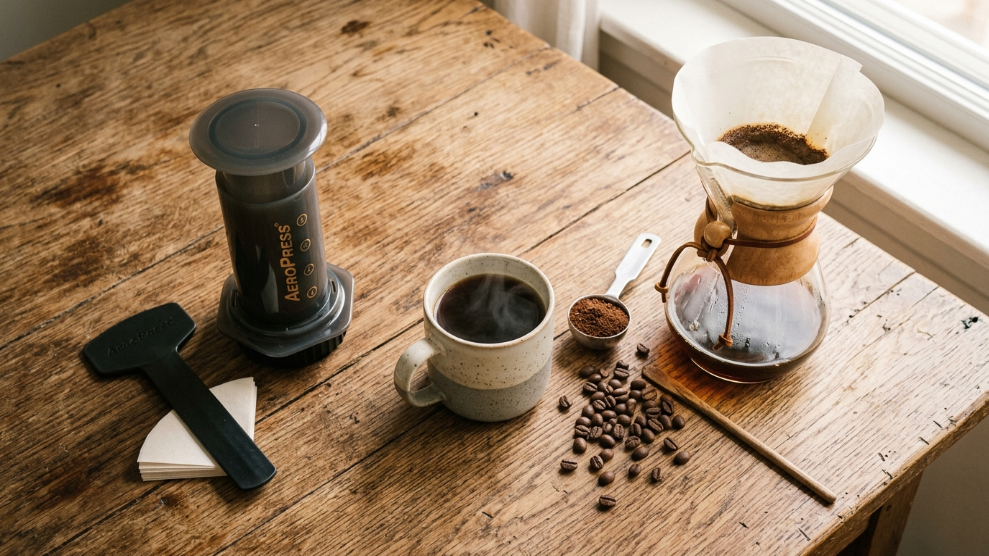
The AeroPress and Chemex are among the most respected manual coffee brewers in the world. The AeroPress has won more World Brewers Cup competitions than any other single brewer in recent years. The Chemex (designed 1941) sits in the permanent collection of the Museum of Modern Art in New York. Both are used by World Barista Championship competitors. Both cost under $60.
They produce genuinely different cups through genuinely different methods and which one is right for you depends entirely on how you drink coffee and what qualities you value in the cup.
Table of Contents
The Fundamental Method Difference
Before comparing taste, it is worth understanding why the cups are different at the technical level:
AeroPress: Combines immersion (grounds steeped in hot water like French press) with pressure (plunger forces water through a filter). The pressure is approximately 0.75 bar not true espresso pressure (9 bar) but enough to produce a concentrated, smooth, full-bodied cup with slight oil character from the paper or metal filter.
Chemex: Pure percolation hot water poured over grounds sitting on a thick proprietary bonded paper filter. Water flows through by gravity only. No pressure involved. The thick filter is the defining feature: it retains 95 to 99% of coffee oils, producing a strikingly clean, tea-like cup where aromatic compounds are the dominant flavour character.
Full Head-to-Head Comparison
| Factor | AeroPress | Chemex |
|---|---|---|
| Price | ~$35 to $45 | AeroPress XL (2026): ~$60 | ~$45 to $65 (3-cup to 10-cup) |
| Brew method | Immersion + pressure | Pour-over percolation |
| Brew time | 2 to 3 minutes total | 4 to 6 minutes |
| Capacity | Standard: 1 to 2 cups. XL (2026): up to 4 large cups | 3, 6, 8, or 10-cup options |
| Coffee oil retention | 60 to 80% of oils pass through (with paper filter) | 1 to 5% of oils pass through (thick bonded filter) |
| Cup character | Full-bodied, rich, complex, slight oil presence | Crystal clear, bright, aromatic, tea-like, sweet |
| Technique difficulty | Low very forgiving of water temperature, timing, and pour | Medium spiral pour technique and grind size are critical |
| Gooseneck kettle needed | No standard kettle works fine | Strongly recommended for consistent results |
| Portability | Excellent compact, plastic, travel-ready, no breakable parts | Poor borosilicate glass, stationary home brewer |
| Cleaning | 30 seconds eject puck, quick rinse | 2 to 3 minutes glass and wooden collar require care |
| Paper filter cost | ~$7 for 350 standard filters | ~$8 to $10 for 100 Chemex proprietary filters |
| Metal filter option | Yes eliminates ongoing paper cost | Yes but changes cup profile significantly (more oils) |
| Recipe variety | 100+ documented recipes (inverted, espresso-style, cold brew) | One primary method with technique variations |
| Competition use | Most World Brewers Cup winning recipes use AeroPress | Strongly featured in World Barista Championship tasting |
AeroPress: Full Assessment

Price: approximately $35 to $45 standard | AeroPress XL approximately $60 (launched January 2026)
Buy: Amazon AeroPress Coffee Maker
What the AeroPress Actually Produces
As confirmed by Tom’s Guide’s AeroPress vs Chemex taste test: “I think AeroPress wins by the tiniest margin. The brew is soft and airy like a coffee-flavored cloud, but doesn’t lack the depth and strength you might expect from a gentle roast.”
The combination of immersion and pressure creates a cup that sits between French press (full body, sediment) and pure pour-over (clean, bright). More oils than a Chemex cup, less than a French press. The partial pressure adds a smooth, rounded quality that is distinct from gravity-only pour-over.
The 100+ Recipe Advantage
The AeroPress has an active global competition community the World AeroPress Championship that has developed over 100 documented recipes. These range from espresso-style concentrates (short, intense) to long, filter-style brews, to the inverted method (flip the AeroPress upside-down to control steeping time), to cold brew concentrates.
As confirmed by Coffee Chronicler’s Chemex vs AeroPress comparison: “The massive upside of the AeroPress is that there are so many ways to brew it.” For buyers who enjoy experimenting and developing their brewing craft, the AeroPress is uniquely flexible.
Why AeroPress Is Best for Beginners
As confirmed by BrewPathFinder’s 90-cup independent 2026 test: “AeroPress is second-easiest [after French Press]. Chemex requires the most skill because pour-over technique directly affects extraction quality.” AeroPress beginners consistently produce good cups on their first attempt without prior training or equipment beyond a kettle.
The AeroPress XL (January 2026): AeroPress launched the XL in January 2026 at approximately $60. Brews up to 4 large cups per press. This directly addresses the original AeroPress’s primary limitation (small capacity) for household use.
AeroPress Travel and Portability
The AeroPress is unbreakable, compact enough to fit in a laptop bag, and requires only a heat source and kettle no electricity, no breakable glass. It is the first manual brewer recommended for travel, camping, hotel rooms, and office desks.
Chemex: Full Assessment

Price: approximately $45 to $65 depending on size (3-cup to 10-cup)
Buy: Amazon Chemex 6-Cup Classic
The Filter: Why It Changes Everything
The Chemex filter is one third thicker than standard pour-over filters. As confirmed by Drip Roast’s Chemex vs V60 analysis: “The Chemex’s thick bonded paper retains 95 to 99% of the oils. What’s left is a tea-like cup florals get amplified because they aren’t competing with mouthfeel.”
This oil removal is the defining characteristic of Chemex coffee. It is not a limitation it is a deliberate flavour choice. A washed Ethiopian Yirgacheffe brewed in a Chemex produces a cup where jasmine, citrus, and berry aromatics are exceptionally clear, unobscured by oil or body.
What the Chemex Produces
As confirmed by Balance Coffee’s multi-brewer experiment: “The Chemex produced a lighter and milder coffee taste. The thick filter paper ensures only the purest coffee flavour gets through. Ideal for those who enjoy subtle and delicate coffee flavours.”
For medium roasts specifically balanced, sweet, with caramel and soft fruit notes the Chemex produces the clearest, sweetest expression of those qualities of any manual brewer. The coffee tastes like the bean, not like a brewing method.
Capacity: The Chemex Group Brewing Advantage
The Chemex’s biggest practical advantage over the AeroPress is capacity. The 6-cup Chemex (standard) brews approximately 900ml per cycle. The 10-cup brews approximately 1.4 litres enough for 4 to 6 people without multiple brewing cycles. For household morning brewing, weekend brunch, or guests, no manual brewer handles group volumes as elegantly as the Chemex.
Technique Requirement: The Learning Curve
As confirmed by Coffee Chronicler: “A novice home barista might cause water to run continuously down one section of the brewing channeling which creates an uneven cup. The solution is a consistent spiral pour technique and a gooseneck kettle. This is learnable in 3 to 5 brew sessions it is not difficult, but it requires initial attention that the AeroPress does not.
The Chemex as a Design Object
The Chemex was designed in 1941 by chemist Peter Schlumbohm and selected for the permanent collection of the Museum of Modern Art. It remains manufactured in essentially the same form today. For buyers who value the aesthetic of their kitchen equipment as much as the functional output, the Chemex is uniquely beautiful.
Which Roasts Work Best in Each Brewer
| Roast level | AeroPress result | Chemex result |
|---|---|---|
| Light roast (single origin) | Bright, complex, slightly oily excellent | Crystal clear florals and fruit exceptional |
| Medium roast | Balanced, sweet, full body very good | Balanced, sweet, clean, aromatic excellent |
| Dark roast | Bold, smooth, strong good | Clean roast notes, less bitterness than most methods good |
Frequently Asked Questions
Which makes better coffee: AeroPress or Chemex? Neither is objectively better they produce different cups. AeroPress produces full-bodied, rich, complex coffee with slight oils. Chemex produces crystal-clear, aromatic, tea-like coffee with minimal oils. As confirmed by Tom’s Guide’s tested comparison: “AeroPress wins by the tiniest margin” in overall taste intensity. Chemex wins on clarity and aromatic purity. Your preferred cup character determines the answer.
Is AeroPress good for beginners? Yes the most forgiving manual brewer available. As confirmed by BrewPathFinder’s 90-cup test: “Chemex requires the most skill; AeroPress is second-easiest after French Press.” AeroPress beginners produce good results on the first attempt. A standard kettle is sufficient no specialist equipment needed.
Do I need a gooseneck kettle for AeroPress and Chemex? AeroPress: no a standard kettle works fine. The AeroPress tolerates imprecise pouring without quality loss. Chemex: strongly recommended. The gooseneck’s controlled, slow pour is the primary factor in even extraction. Without it, channeling (uneven water distribution) is more likely, producing inconsistent results.
Can AeroPress make espresso? Not true espresso AeroPress generates approximately 0.75 bar versus 9+ bar for true espresso. It produces a concentrated, smooth coffee that functions as an espresso substitute in lattes and americanos, but is not technically espresso. For true espresso, see: Best Espresso Machines 2026
What grind size for AeroPress and Chemex? AeroPress: medium-fine to medium, depending on recipe. The inverted method at medium works well. Competition recipes vary widely. Chemex: medium-coarse similar to table salt. Too fine causes stalling; too coarse causes under-extraction and fast drainage. For detailed grind guidance: Coffee Grind Size Guide
Which has lower ongoing filter costs? AeroPress: $7 for 350 standard paper filters, or a one-time $15 to $25 metal filter that eliminates ongoing costs. Chemex: $8 to $10 for 100 proprietary bonded filters approximately 3.5x more per filter than AeroPress. The Chemex metal filter option exists but significantly changes the cup character (more oils, less aromatic clarity). Over one year of daily use, the filter cost difference is approximately $20 to $35.
For the AeroPress vs French Press comparison: AeroPress vs French Press
For the best grind for each brewer: Coffee Grind Size Guide
For V60 vs Chemex specifically: V60 vs Chemex
Sources: BrewPathFinder Chemex vs AeroPress vs French Press 90-Cup Test 2026 / Tom’s Guide AeroPress vs Chemex taste test / Coffee Chronicler Chemex vs AeroPress / Drip Roast Chemex vs V60 May 2026 / Balance Coffee Multi-Brewer Experiment / Corner Coffee Store AeroPress vs Chemex 2026

Munir Ahmed is the founder of Coffee Craft Guide, dedicated to building the most thorough and honest coffee resource for home brewers worldwide. Combining SCA brewing standards with deep-dive research across global coffee communities (like r/espresso and Home-Barista) and thousands of verified reviews, Munir and his team deliver data-backed, expert coffee insights you can trust.