
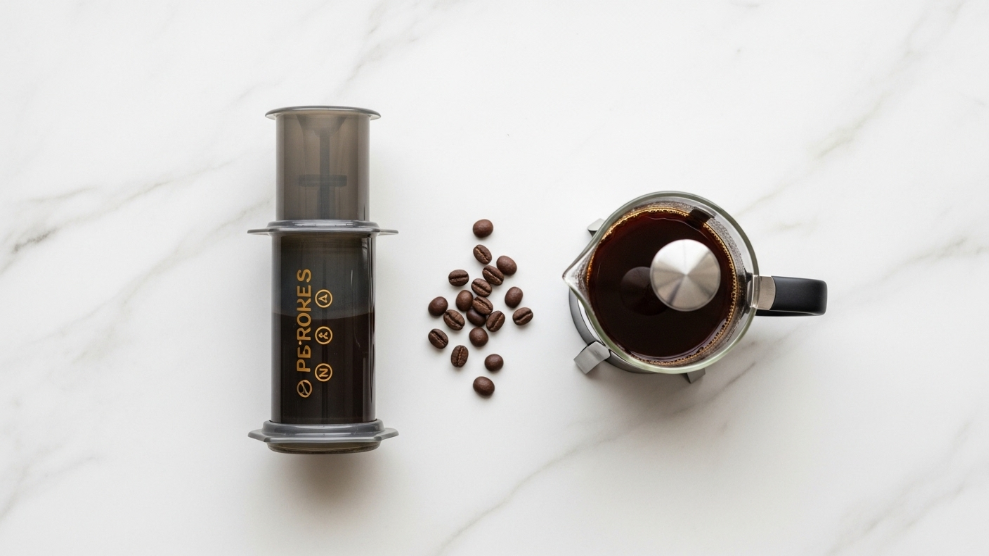
The AeroPress and the French press are the two most popular manual coffee makers in the world. Both are affordable, require no electricity, produce good coffee, and have passionate communities of loyal users. But they produce noticeably different cups, suit different lifestyles, and involve different levels of effort and cleanup.
This comparison covers the real differences between the two methods, which one produces better coffee in which situations, the honest trade-offs of each, and which one to buy based on your specific priorities.
Table of Contents
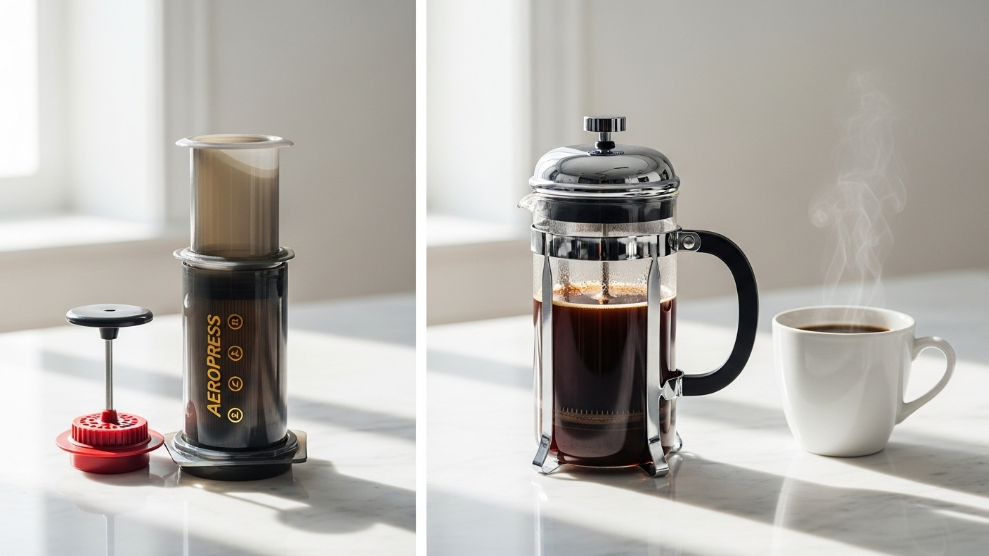
Quick Comparison
| Factor | AeroPress | French Press |
| Brew time | 1 to 2 minutes | 4 to 5 minutes |
| Cleanup | Very easy, 30 seconds | Moderate, 2 to 3 minutes |
| Cup clarity | Clean, no sediment | Full body, some sediment |
| Travel | Excellent, lightweight, tough | Fragile glass, bulky |
| Grind | Medium-fine to fine | Coarse only |
| Price | 45 to 50 USD | 15 to 70 USD depending on model |
| UK name | AeroPress | Cafetiere (same device) |
| Best for | Travel, fast mornings, variety | Weekend brewing, full body fans |
| Skill needed | Moderate | Low |
The AeroPress: What It Is
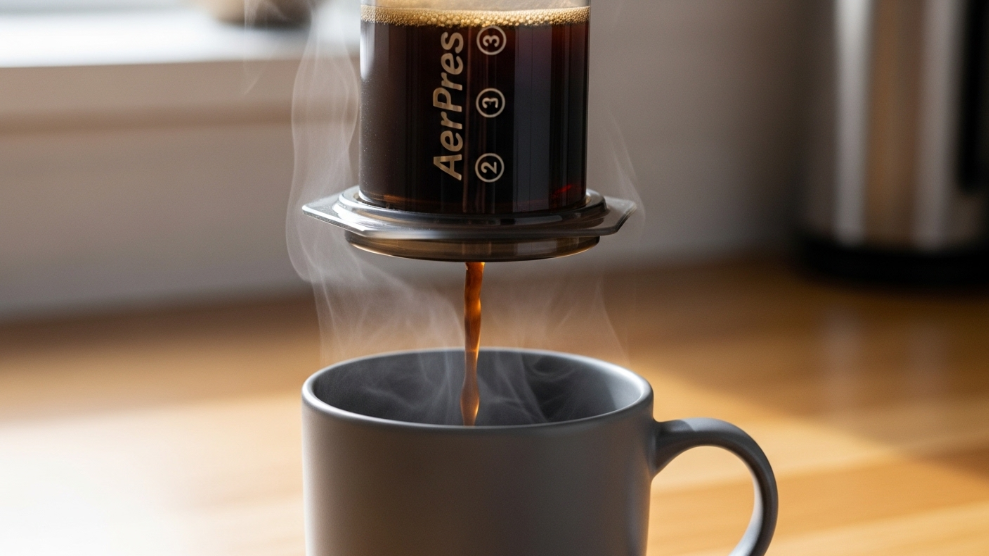
The AeroPress was invented by Alan Adler, a Stanford engineering lecturer, and released in 2005. Adler also invented the Aerobie flying ring. He set out to make a coffee maker that produced excellent espresso-style coffee quickly with no bitterness, and the AeroPress has become one of the most successful coffee maker innovations of the past 30 years.
The device is a plastic cylinder with a plunger. Ground coffee and water are combined in the cylinder, steeped briefly, then pushed through a paper or metal filter by pressing the plunger. The entire process takes 1 to 2 minutes.
What the AeroPress does well
- Produces a clean, smooth cup with no sediment because the paper filter removes oils and fine particles
- Extremely fast: 1 to 2 minutes from grinding to drinking
- Cleanup takes 30 seconds: eject the puck, rinse the seal
- Nearly indestructible: the plastic body survives drops, bags, travel conditions
- Versatile: use it as a standard brewer, invert it, or brew espresso-style concentrate
- Has its own world championship: the World AeroPress Championship has been running since 2008
AeroPress honest limitations
- Brews one cup at a time, maximum 250 to 300ml per press
- Requires paper filters (metal filters available but change the cup character)
- Slightly more technique involved than French press
Check current price: Amazon US AeroPress Original | Amazon UK | Amazon AU
AeroPress Go (travel version): Amazon US | Amazon UK | Amazon AU
The French Press and Cafetiere: What It Is

UK note: French press and cafetiere are the same device. The cafetiere name is the standard British term. Throughout this article both names refer to identical equipment.
The French press uses immersion brewing: coarsely ground coffee and hot water are combined in a glass or stainless steel cylinder, steeped for 4 minutes, then a metal mesh plunger is pressed down to separate the grounds from the liquid. The brewed coffee is poured directly from the top.
Unlike the AeroPress which filters the oil and fine particles out, the French press metal mesh allows both to pass through into the cup. This produces the characteristic full body, rich texture, and slight sediment at the bottom of the cup that French press drinkers specifically value.
What the French press does well
- Produces a full-bodied, rich, textured cup that no paper-filtered method replicates
- Can brew 2 to 8 cups simultaneously: ideal for households or hosting
- Simple technique with no skill ceiling: steep and press
- Wide variety of sizes from 350ml single-cup to 1 litre
- Lower cost entry point: quality French presses start at 15 to 25 USD
French press honest limitations
- Sediment always present: grounds settle at the bottom of the cup
- Metal mesh filter allows coffee oils through: higher cafestol content, which affects cholesterol in high quantities for sensitive individuals
- Glass body is fragile and heavy for travel
- Cleanup takes longer than AeroPress: dismantling the plunger, cleaning the mesh
- Requires coarse grind only: fine or medium grounds produce over-extracted, muddy cups
Recommended French Press Options
Check current price: Amazon US Bodum Chambord French Press | Amazon UK
Check current price: Amazon US ESPRO P7 French Press (best for no sediment) | Amazon UK
ESPRO P7 note: the ESPRO P7 uses a dual micro-filter that eliminates sediment from a French press. It produces a cleaner cup than standard French press while keeping the full body. Recommended for buyers who want French press body without sediment.
Taste Comparison: Which Produces Better Coffee?

Neither is objectively better. They produce different cups by design.
AeroPress cup character
The AeroPress produces a clean, bright, smooth cup with no sediment. Paper filters remove the coffee oils and fine particles that French press retains, resulting in a cup clarity similar to pour-over. The flavour is focused and clear. Specialty single-origin coffees show their origin character more distinctly through an AeroPress than through a French press.
The AeroPress also allows more flavour exploration than any other manual brewer. You can brew espresso-style concentrate, long filter-style coffee, or anything between, by adjusting the ratio, steep time, and temperature.
French press cup character
The French press produces a full-bodied, rich, textured cup. The retained coffee oils contribute mouthfeel and a heavier texture that many drinkers specifically prefer. Dark roast beans and medium-dark blends shine in a French press in a way they do not in a paper-filtered method.
The slight sediment at the bottom is not a defect it is a characteristic that experienced French press drinkers expect and appreciate. Stopping pouring before the sediment level is reached gives a cleaner final cup.
For specialty coffee and origin exploration: AeroPress produces better cup clarity and allows more extraction control.
For full body and everyday drinking: French press produces the richer, heavier cup that many daily coffee drinkers prefer.
Which Is Easier to Use?
French press wins for simplicity. Coarse grind, add hot water, wait 4 minutes, press, pour. There is almost nothing that can go wrong if you use the correct coarse grind and wait the correct time.
AeroPress requires slightly more technique. The inverted method, paper filter placement, and pressing speed all affect the result. The learning curve is short most people produce good results within 3 to 5 brews but it is a steeper initial curve than French press.
For someone new to manual coffee making who wants a simple, reliable method: French press is the easier starting point.
Cleanup: AeroPress Wins Clearly
AeroPress cleanup is 30 seconds. Remove the filter cap, push the plunger over a bin and the spent puck ejects cleanly, rinse the rubber seal under the tap, done.
French press cleanup takes 2 to 4 minutes. The wet spent grounds must be scooped or rinsed out of the cylinder, the metal mesh plunger must be unscrewed and rinsed, and coffee oils build up in the mesh over time requiring periodic deeper cleaning.
For weekday morning brewing where speed matters, the AeroPress cleanup advantage is significant.
☕ Free Tools for This Guide
Both methods need the right ratio and grind. Use our Coffee to Water Ratio Calculator and the Coffee Grind Size Chart. Free download: the Brewing Methods Poster (PDF).
Travel: AeroPress is the Clear Winner
The AeroPress is designed for travel. The standard AeroPress weighs 250g and packs flat. The AeroPress Go is an even more compact version designed specifically for travel with its own mug and carrying case.
French press glass bodies are fragile and heavy. Stainless steel French presses (such as the Frieling or ESPRO) address the fragility concern but remain heavier than the AeroPress. For camping, backpacking, hotels, and office use, the AeroPress is the practical choice.
Hosting and Volume: French Press Wins
The AeroPress brews one cup at a time. If you are hosting three people for coffee, you need to brew three sequential AeroPress cycles.
A 1-litre French press brews 4 to 5 cups simultaneously in one 5-minute cycle. For households or hosting situations, the French press’s volume advantage is significant.
Grind Requirements
AeroPress: Medium-fine to fine grind, adjustable based on method. The standard recipe uses medium-fine (similar to pour-over). The AeroPress accepts a wide range of grind sizes because steep time and ratio compensate for grind variation.
French press: Coarse grind only. Fine or medium grounds over-extract during the 4-minute steep, producing a bitter, muddy cup. The coarse grind requirement also means your grinder settings shift significantly if you switch between French press and espresso.
Grind size reference for both methods: Coffee Grind Size Chart
Best grinders for both methods: Best Coffee Grinders 2026
UK, Australia and New Zealand Notes
UK
The cafetiere is the most used manual coffee maker in UK homes and has been for decades. UK supermarkets stock a wide range of cafetieres at all price points. The AeroPress is widely available on Amazon UK and in specialty coffee shops.
For UK buyers: if you want to replicate the type of coffee your local specialty cafe serves filter-style, the AeroPress is closer to what they use. If you want the classic British morning coffee ritual, the cafetiere remains the more traditional choice.
Australia and New Zealand
Australia and New Zealand have espresso-dominated coffee cultures, and both the AeroPress and French press sit outside the mainstream of flat white and latte culture. However, both are popular in specialty coffee communities.
Australian and New Zealand specialty cafe baristas who brew at home often own both an AeroPress and an espresso setup. The AeroPress is used for filter-style specialty exploration and travel, while the espresso machine handles daily flat whites.
AeroPress Recipe: Standard Method
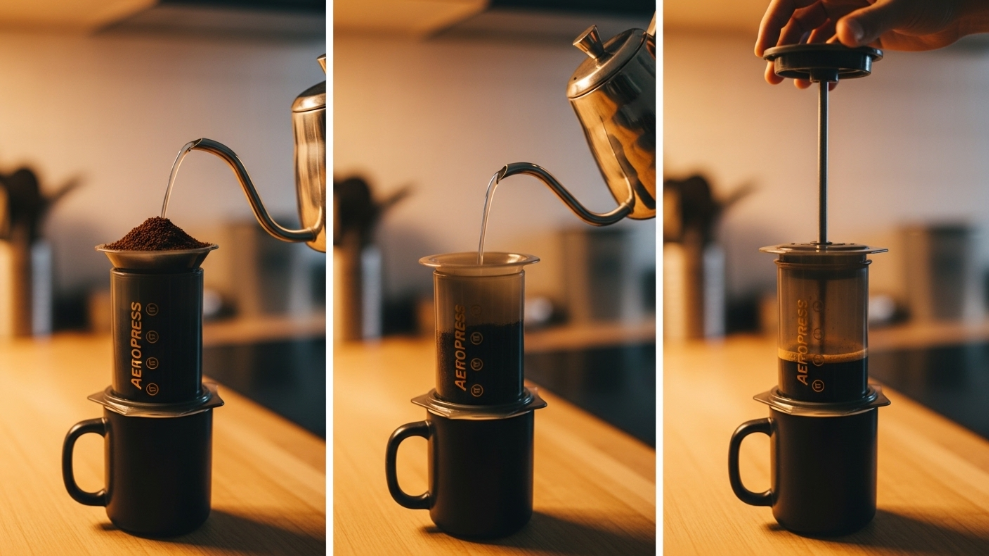
Dose: 17g coffee. Water: 255ml at 90 to 93 degrees Celsius.
Step 1: Place a paper filter in the filter cap and rinse with hot water.
Step 2: Add 17g of medium-fine ground coffee to the AeroPress chamber.
Step 3: Start a timer. Pour 255ml of water at 90 to 93 degrees Celsius.
Step 4: Stir once gently.
Step 5: Place the plunger on top to create a seal. Do not press yet.
Step 6: At 1 minute 30 seconds, begin pressing slowly. Full press takes 20 to 30 seconds.
Step 7: Stop pressing when you hear a slight hiss. Serve immediately.
For exact ratio at any amount: Coffee to Water Ratio Calculator
French Press Recipe: Standard Method
Dose: 33g coffee. Water: 500ml at 92 to 96 degrees Celsius.
Step 1: Preheat the French press with hot water. Discard the preheat water.
Step 2: Add 33g of coarsely ground coffee.
Step 3: Pour 500ml of water at 92 to 96 degrees Celsius over the grounds.
Step 4: Stir once gently to ensure all grounds are saturated.
Step 5: Place the lid on with the plunger raised. Do not press yet.
Step 6: At exactly 4 minutes, press the plunger down slowly and evenly.
Step 7: Pour immediately. Do not leave brewed coffee on the grounds as it continues extracting.
Frequently Asked Questions
Can you use the AeroPress to make espresso?
The AeroPress can produce a strong, espresso-style concentrate but it is not true espresso. True espresso requires 9 bars of pressure, which the AeroPress does not reach. The AeroPress produces approximately 0.5 to 0.75 bars of pressure from manual pressing. The result is a concentrated, strong coffee that works well diluted with water (long black style) or used as a base for milk drinks. For true espresso, an espresso machine is required.
Which has more caffeine, AeroPress or French press?
The caffeine content depends on the dose and ratio used, not the brewing device. Both methods extract caffeine efficiently. At equivalent doses and ratios, an AeroPress cup and a French press cup contain similar caffeine. See: Caffeine Content in Every Coffee Type
Is the French press bad for your health?
French press coffee retains cafestol, a compound in coffee oil that can raise LDL cholesterol with regular high consumption. For most people drinking 1 to 2 cups per day, the effect is minor. People with high cholesterol or cardiovascular concerns who drink 4 or more French press coffees per day may benefit from switching to a paper-filtered method. This is not a concern at moderate consumption levels for the general healthy population.
Which is better for specialty coffee?
The AeroPress produces better cup clarity for specialty single-origin coffees, particularly light roast Ethiopian and Kenyan origins where floral and fruity notes are the main attraction. The paper filter removes oils that can mask delicate aromatic compounds. For specialty coffee exploration, the AeroPress is the more revealing tool. See: What Is Specialty Coffee?
Can I own both?
Yes, and many home coffee drinkers do. The AeroPress (from 45 USD) and a standard cafetiere (from 15 to 20 USD) together cost under 70 USD total. Using the AeroPress for fast weekday coffees and the French press for weekend batch brewing or when hosting is a common and practical setup.
Our Verdict
Buy the AeroPress if: you prioritise cleanup speed, travel use, brewing single specialty-grade cups with clarity, or you want versatility in recipes and methods.
Buy the French press if: you prefer a full-bodied, richer cup, you brew for multiple people regularly, you want the lowest-effort manual brew method, or you want the classic cafetiere ritual that has been part of British morning culture for decades.
Buy both if: you have the budget. At a combined cost of under 70 USD, owning both covers every manual brewing scenario.
Check current price: AeroPress Original Amazon US | Amazon UK | Amazon AU
Check current price: Bodum Chambord French Press Amazon US | Amazon UK
Sources: AeroPress Official | SCA Brewing Standards | r/Coffee AeroPress Guide | r/Coffee French Press Guide

Munir Ahmed is the founder of Coffee Craft Guide, dedicated to building the most thorough and honest coffee resource for home brewers worldwide. Combining SCA brewing standards with deep-dive research across global coffee communities (like r/espresso and Home-Barista) and thousands of verified reviews, Munir and his team deliver data-backed, expert coffee insights you can trust.