
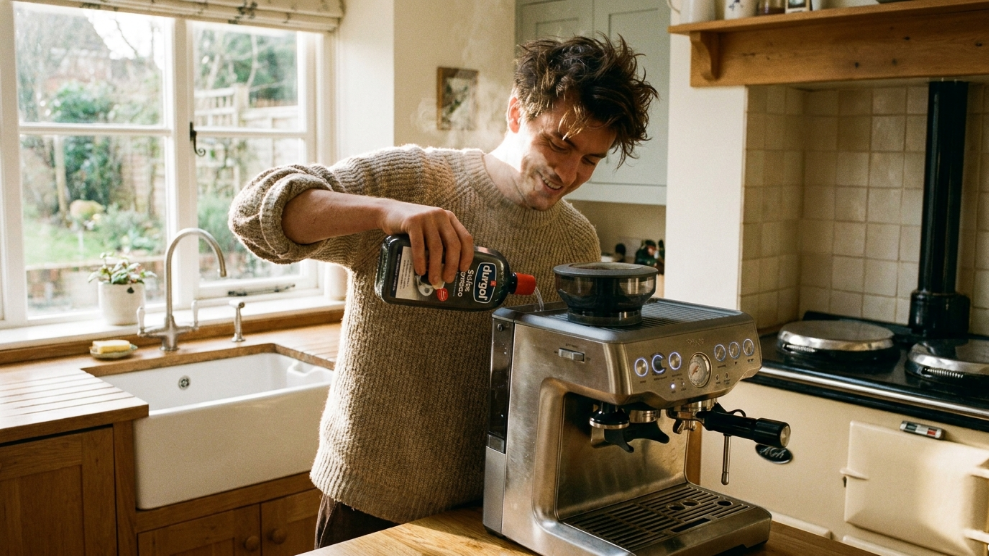
Most of England has hard water. London, the South East, East Anglia, the Midlands, and large parts of Yorkshire all have water with high mineral content primarily calcium and magnesium carbonate. Every time this water is heated inside your coffee machine, those minerals deposit on the boiler, heating element, tubes, and spray heads as limescale.
Limescale has no visible symptoms until it has already reduced your machine’s performance. By the time you notice your coffee tasting flat, your machine running louder, or your brew taking longer, the buildup is significant. The fix is descaling and doing it regularly before the symptoms appear is far easier than clearing advanced buildup.
This guide covers the three descaling options available to UK buyers, how often to descale based on your area’s water hardness, and step-by-step instructions for every common machine type.
Table of Contents
Why UK Buyers Need to Descale More Often
Water hardness is measured in milligrams per litre of calcium carbonate (mg/l CaCO3) or parts per million (ppm). The UK Drinking Water Inspectorate classifies water hardness as:
| Classification | Level (mg/l CaCO3) | UK areas affected | Descale frequency |
|---|---|---|---|
| Soft | 0 to 100 | Scotland, Wales, Northern Ireland, parts of North West England | Every 4 to 6 months |
| Moderately hard | 100 to 200 | Parts of Northern England, South West | Every 3 to 4 months |
| Hard | 200 to 300 | Midlands, Yorkshire, parts of the South East | Every 2 to 3 months |
| Very hard | 300+ | London, East Anglia, much of the South East | Every 6 to 8 weeks |
London’s water is among the hardest in Europe. A London coffee machine left undescaled for 6 months accumulates significant limescale that reduces boiler efficiency, increases energy consumption, and affects extraction temperature and therefore coffee flavour.
For a detailed guide to how hard water affects coffee taste and what to do about it: Hard Water and Coffee: Complete UK Guide
The Three Descaling Options: Branded, Citric Acid, and Vinegar
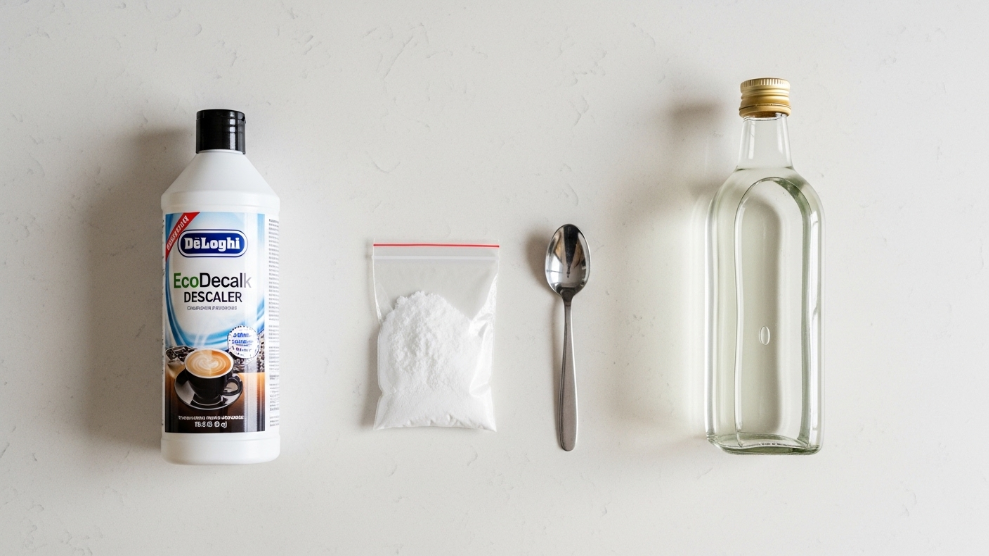
Option 1: Branded Descaler (Recommended for Machines Under Warranty)
Branded descalers are formulated by the machine manufacturer specifically for the internal components of their machines. They are engineered to dissolve calcium carbonate effectively without being corrosive to rubber seals, aluminium heating elements, or metal tubes.
Use branded descaler when:
- Your machine is under warranty (using a non-approved descaler can void it)
- The machine’s indicator light requests a specific brand’s descaler
- You own a Jura machine (Jura’s cleaning tablets and descalers are specifically formulated for their systems)
- You own a Nespresso (Nespresso descaling solution maintains warranty compliance)
Available branded descalers in the UK:
De’Longhi EcoDecalk on Amazon UK approximately £10 to £14 for 500ml. For all De’Longhi machines.
Sage Descaler on Amazon UK approximately £12 to £15 for 250ml. For all Sage machines.
Jura Descaling Tablets on Amazon UK approximately £10 to £13 for 3 tablets. Required for Jura machines.
Nespresso Descaling Kit on Amazon UK approximately £8 to £12 for 2 sachets. Specifically for Nespresso machines.
Option 2: Citric Acid (Best DIY Alternative)
Citric acid is highly effective at dissolving calcium carbonate, pH-safe for coffee machine internals, leaves zero taste residue after rinsing, and is food-safe.
Citric acid has a lower pH level than vinegar, so you will not have to contend with lingering odours as you do with vinegar.
Mixing ratio: 1 tablespoon (approximately 15g) of food-grade citric acid powder dissolved in 1 litre of warm water.
Food Grade Citric Acid Powder on Amazon UK approximately £5 to £8 for 500g, which provides 30 to 35 descaling treatments. The most cost-effective option for frequent descalers in hard water areas.
Important: Use food-grade citric acid only, not industrial-grade. Food-grade is widely available in UK supermarkets (baking section) and online.
Option 3: White Vinegar (Emergency Use Only)
Do not use undiluted vinegar it can degrade rubber seals with repeated use and is very difficult to fully rinse out.
Because there are porous surfaces in your brewer, the vinegar can leach into those surfaces and linger for a long time.
White vinegar will descale a coffee machine any acid will. But it requires significantly more rinse cycles than citric acid or branded descalers to eliminate the acetic acid odour from porous components, and repeated use can degrade the rubber seals and gaskets that prevent leaks.
When vinegar is acceptable: For a single emergency descale of a machine you are planning to replace, or for external parts like the carafe or drip tray. Not recommended for regular use in any machine.
Signs Your Machine Needs Descaling
If your coffee tastes flat, your machine runs louder than usual, or brew times have slowed, it is probably time to descale. Telltale signs you waited too long: visible white crust inside the reservoir, sputtering or reduced flow, cooler coffee, or a sour or bitter aftertaste that shows up even with fresh beans.
Additional UK-specific signs:
- White chalky residue visible inside the water tank or on the spout
- Steam wand producing weaker or uneven steam
- Machine taking noticeably longer to reach operating temperature
- The machine’s built-in descale indicator light (most modern machines have this)
Step-by-Step: Universal Descaling Method
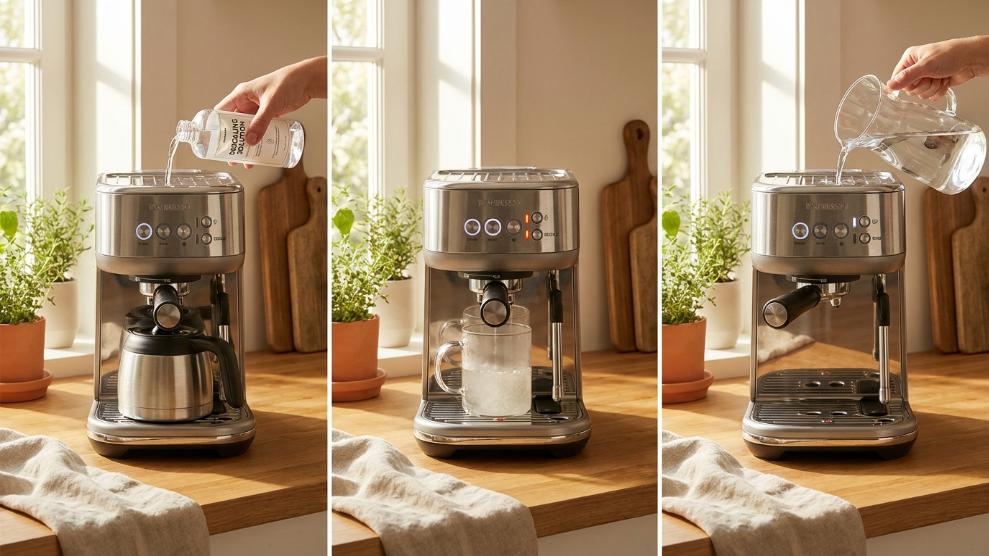
This method applies to most machines. Always check your specific machine’s manual for model-specific instructions some machines require a specific descale mode activated through the menu.
What you need:
- Descaling solution (branded, citric acid, or filtered water rinse for light scale)
- Large jug or bowl for catching the solution
- Fresh cold water for 2 to 3 rinse cycles
Step 1: Empty the machine completely. Remove any coffee pods, ground coffee, and used coffee from the brew group. Empty the drip tray and grounds container.
Step 2: Remove the water filter from the tank if present (De’Longhi, Jura, and Philips machines all have water filters). Descaling solution must not pass through the water filter remove it first and replace after descaling is complete.
Step 3: Prepare your descaling solution. For branded descalers follow the packet instructions. For citric acid: dissolve 1 tablespoon per litre of warm water, then allow to cool before adding to the reservoir.
Step 4: Fill the water tank with the descaling solution. Place a large jug under the spout to catch the liquid that passes through.
Step 5: Activate the descale programme. On most modern bean to cup machines (De’Longhi Magnifica, Jura, Philips), the descale programme is found in the Settings or Maintenance menu. On espresso machines (Sage Barista Express), refer to the manual for the specific button combination that activates the descale cycle. On Nespresso machines, the descale mode is typically activated by holding both buttons simultaneously for 3 seconds.
Step 6: Allow the full descale cycle to complete. This typically takes 20 to 30 minutes. The machine pumps the solution through the boiler, tubes, and spray heads in stages.
Step 7: Rinse cycle 1. Empty the collection jug, fill the tank with fresh cold water, and run a full rinse cycle.
Step 8: Rinse cycle 2. Repeat with a second tank of fresh cold water. For machines that have been heavily scaled or where vinegar was used, run a third rinse cycle.
Step 9: Reinstall the water filter. Refill with fresh water and the machine is ready for use.
Machine-Specific Notes
De’Longhi Magnifica (all models)
De’Longhi recommends their own EcoDecalk descaler. The Magnifica range has a built-in descale alert that activates when the machine calculates sufficient mineral accumulation based on water hardness setting and usage. Set the water hardness correctly during initial setup this calibrates the descale reminder accurately for your UK area.
Do not ignore the descale alert. De’Longhi’s warranty states that failure to descale at the recommended intervals contributes to premature component failure that is not covered under warranty.
Jura (E-series, J-series)
Jura machines use branded descaling tablets only not liquid solutions, not citric acid. The tablets are specifically formulated for Jura’s stainless steel thermal block and CLARIS water filtration system. Using citric acid or branded liquid descalers from other manufacturers can damage Jura’s components and voids the warranty.
The CLARIS filter in Jura machines reduces the frequency of descaling needed in hard water areas, the filter extends the interval between descaling to approximately every 3 to 4 months compared to 6 to 8 weeks for unfiltered machines.
Philips LatteGo (3200, 5400 Series)
Philips recommends the CA6700 or CA6903 descaling solutions. The LatteGo milk system does not require descaling only the main machine body. The LatteGo system requires only daily rinsing under the tap.
The AquaClean filter in Philips machines, if maintained correctly, can allow up to 5,000 cups between descaling rather than the standard interval however, this requires replacing the filter at the recommended intervals.
Sage Barista Express and Bambino Plus
Sage UK recommends their own branded descaler. The descale cycle on Sage machines is activated by holding a specific button combination detailed in the manual for each model. Sage recommends descaling every 2 months in hard water areas regardless of indicator lights.
Full UK guide for Sage machines: Best Sage Coffee Machines UK 2026
Nespresso (Original and Vertuo)
Use the official Nespresso descaling solution to maintain warranty compliance. Nespresso’s descale mode varies by model check the Nespresso UK website for your specific machine’s descale activation sequence. The process typically takes 20 minutes and requires two rinse cycles.
Nespresso recommends descaling every 3 months or after approximately 300 capsules, whichever comes first.
Filter and Drip Coffee Machines
Filter machines accumulate limescale in the water tank, heating element, and shower head. The descaling process is simpler than espresso machines fill the tank with diluted citric acid solution (1 tablespoon per litre), run a full brew cycle, then run 2 full cycles with clean water.
What Happens If You Never Descale
The progressive consequences of limescale buildup:
1 to 3 months without descaling in a hard water area: heating efficiency begins to decline, brewing temperature drops below optimal. Coffee tastes slightly flat.
3 to 6 months: visible scale on internal components. Brew time increases. Steam output reduces.
6 to 12 months: significant heating element scale. Increased energy consumption. Potential pump strain from restricted water flow.
Over 12 months: risk of permanent heating element damage, pump failure, or boiler cracking from uneven heat distribution through scale deposits. These failures are typically not covered under warranty.
Frequently Asked Questions
Can I use white vinegar instead of a coffee machine descaler?
A commercial descaler is almost always your safest bet it has been designed by people who know exactly what materials are inside your coffee machine. These solutions are typically non-corrosive and rinse away clean, meaning no weird aftertaste. White vinegar in an emergency is technically workable but requires significantly more rinse cycles and risks degrading rubber seals with repeated use. Citric acid is the better DIY alternative in all situations.
How often should I descale my coffee machine in London?
London has very hard water (300+ mg/l CaCO3). Most machine manufacturers recommend descaling every 6 to 8 weeks for London users. Use your machine’s water hardness setting to set this correctly the machine will calculate its own reminder interval based on actual usage.
Does using a water filter remove the need to descale?
A water filter reduces the mineral content reaching the boiler, extending the interval between descaling not eliminating it. Jura CLARIS filters significantly extend the interval. Standard machine filters (De’Longhi, Philips AquaClean) help but still require regular replacement and descaling at manufacturer-recommended intervals.
Will descaling fix my coffee tasting bitter or flat?
Possibly. Limescale reduces the boiler’s heating efficiency, causing brew temperature to drop below the optimal 92 to 96°C recommended by the Specialty Coffee Association. Cooler brewing produces under-extracted, flat, or sour coffee. If your coffee quality has gradually declined, descaling is the first thing to try before blaming the beans or grind. For espresso-specific troubleshooting: Why Does My Espresso Taste Sour?
Can I use lemon juice to descale?
Lemon juice contains citric acid and technically works, but the concentration is inconsistent and the juice can leave residue in machine components. Powdered food-grade citric acid produces a consistent, clean, controllable solution at lower cost. Use citric acid powder rather than juice.
Does descaling damage the machine?
No, when done correctly with the appropriate solution at the recommended dilution. Do not leave acid in the machine overnight extended soaking can stress metals and seals. Do not run the machine dry. Do not mix acids with bleach or chlorinated cleaners.
For understanding why UK water hardness affects your coffee beyond just machine maintenance: Hard Water and Coffee: Complete UK Guide
For bean to cup machine buying advice: Best Bean to Cup Coffee Machines UK 2026
For Sage machine-specific descaling guidance: Best Sage Coffee Machines UK 2026
Sources used in this article: UK Drinking Water Inspectorate Water Hardness Data / Specialty Coffee Association Brewing Standards / The Coffee Locator How to Descale a Coffee Machine 2026 / Seven Sisters Coffee Co UK Descaling Guide / The Kitchn Using Citric Acid to Descale / HomeWise Review How to Descale Any Coffee Maker

Munir Ahmed is the founder of Coffee Craft Guide, dedicated to building the most thorough and honest coffee resource for home brewers worldwide. Combining SCA brewing standards with deep-dive research across global coffee communities (like r/espresso and Home-Barista) and thousands of verified reviews, Munir and his team deliver data-backed, expert coffee insights you can trust.