
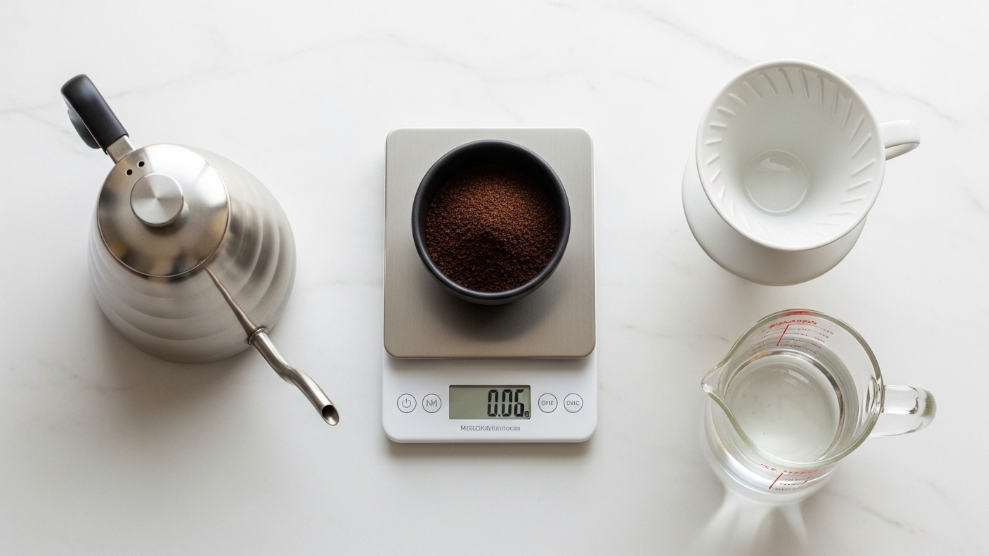
The coffee to water ratio is the single most controllable variable in home coffee brewing. Grind size requires a quality grinder. Water temperature requires a thermometer or a smart kettle. Bean freshness depends on your supplier. But the ratio between coffee and water requires nothing more than a kitchen scale and consistent measurement.
☕ Skip the Maths
Skip the maths: our Coffee to Water Ratio Calculator gives exact coffee and water for 8 methods instantly. Free download: the matching Brewing Ratio Cheat Sheet (PDF).
Getting this ratio right is the difference between a cup that tastes thin and sour, a cup that tastes bitter and harsh, and a cup that tastes balanced. The correct ratio is different for every brew method, and it changes slightly based on the roast level of your beans, your personal taste preferences, and even the hardness of your water.
This guide covers the exact ratios for every major brew method, why weight-based measurement always beats volumetric measurement, how to adjust from a starting point based on taste, and what the Specialty Coffee Association defines as the gold standard for each method.
Table of Contents
Use the Interactive Calculator
Rather than calculating manually, use our ratio calculator to get exact measurements for any amount you want to brew:
Coffee to Water Ratio Calculator
Select your brew method, choose your strength, and enter the water amount. The calculator shows exactly how many grams of coffee to use. It covers pour-over, AeroPress, French press, drip, cold brew, and espresso.
What Is the Coffee to Water Ratio?
The coffee to water ratio is a comparison of how much ground coffee you use relative to how much water you brew with. It is expressed as coffee:water.
A ratio of 1:16 means 1 gram of coffee for every 16 grams of water. A ratio of 1:10 means 1 gram of coffee for every 10 grams of water, producing a stronger cup.
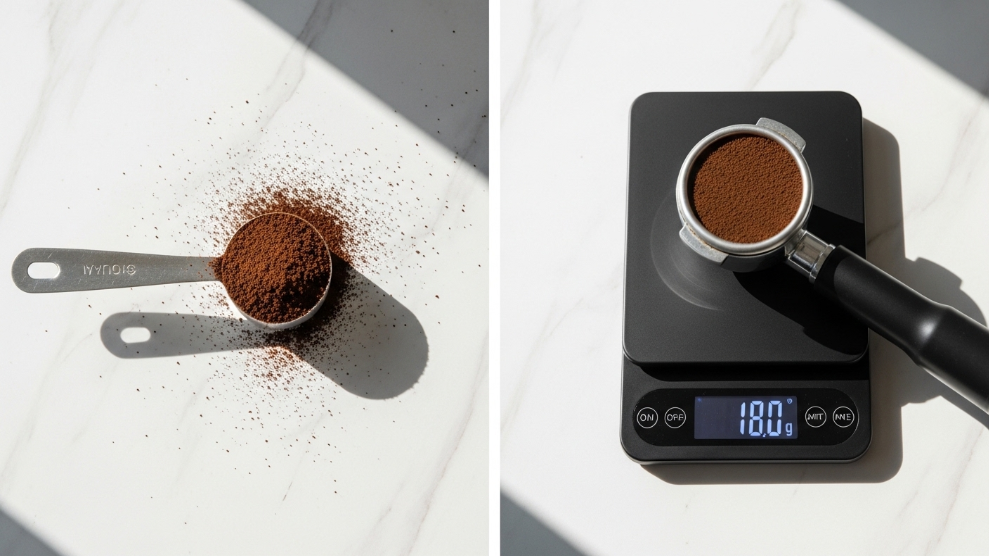
The ratio is always expressed in weight, not volume, for a simple reason: coffee has variable density. A tablespoon of finely ground espresso weighs approximately 7 to 9 grams. A tablespoon of coarsely ground French press coffee weighs approximately 5 to 6 grams. If you measure by spoons and your grind size changes, your actual dose changes even though the spoon count is the same. Weight eliminates this inconsistency entirely.
A 1g of water equals 1ml at room temperature. This means you can measure water by volume in millilitres or by weight in grams interchangeably. Both are equally accurate for water.
Why Weight Beats Volume Every Time
A tablespoon is not a reliable coffee measurement. Here is why this matters practically:
If you use a tablespoon to measure medium-ground drip coffee and then switch to a light roast pour-over grind, the tablespoon contains different weights despite looking the same. The pour-over grind is denser and packs more tightly, so the same spoon volume contains more grams.
If you measure by weight and use 18 grams of coffee every single time, the dose is identical regardless of grind size, roast level, bean variety, or humidity. Weight-based measurement eliminates an entire category of variables that can affect your cup.
The equipment required: any kitchen scale measuring to 1 gram accuracy. These are available for under $15. A coffee-specific scale with a built-in timer, which allows you to track pour speed and total brew time simultaneously, costs $30 to $60.
Amazon US Timemore Black Mirror Coffee Scale / Amazon UK Timemore Coffee Scale / Amazon AU Coffee Scale with Timer
The SCA Golden Cup Standard
The Specialty Coffee Association has established brewing standards through controlled sensory research with trained tasters across multiple countries. Their recommended ratio for filter and drip coffee is:
55 grams of coffee per 1 litre of water (1:18.2)
This is known as the Golden Cup standard. It defines the centre of what trained tasters identified as the most satisfying extraction range across the widest range of palates.
The SCA Golden Cup ratio translates to:
- 1 cup (240ml): 13g coffee
- 1 standard mug (350ml): 19g coffee
- 1 litre batch: 55g coffee
- 1 standard 12-cup drip machine (1.8 litres): 100g coffee
Note that the SCA standard is a starting point for filter drip coffee specifically. Espresso, pour-over, cold brew, and AeroPress all use different ratios by design and for good reason.
Ratios by Brew Method: Complete Breakdown
Pour-Over (V60, Kalita Wave, Chemex)
Recommended starting ratio: 1:16
For a 250ml cup: 16g coffee. For a 300ml cup: 19g coffee. For a Chemex 700ml batch: 44g coffee.
The pour-over range runs from 1:14 (stronger, more intense) to 1:17 (lighter, more delicate). Most specialty coffee professionals start at 1:16 and adjust from there based on the specific bean’s characteristics.
Chemex note: The Chemex uses a thicker paper filter that slows drainage and extends contact time. Some Chemex users prefer 1:17 to compensate for the slightly longer extraction, preventing over-extraction.
V60 vs Kalita ratio difference: The ratio for both is essentially the same (1:15 to 1:17), but the V60’s faster drainage means your pour speed affects extraction more significantly than with the Kalita’s flatter bed.
Adjusting from the 1:16 starting point:
- Cup tastes weak or watery: move to 1:15 or 1:14 (more coffee, same water)
- Cup tastes bitter or harsh: move to 1:17 or 1:18 (less coffee, same water)
- Cup tastes sour: grind finer before adjusting the ratio
Full brewing guide: Pour-Over Coffee Complete Guide
AeroPress
Recommended starting ratio: 1:15
For 200ml yield: 13g coffee. For 250ml yield: 17g coffee.
The AeroPress is the most forgiving brew method for ratio experimentation. Its sealed chamber and pressure pressing mechanism allows ratios from 1:6 (espresso-style concentrate for diluting) to 1:18 (light, delicate filter-style cup). No other home brewing method accommodates such a wide ratio range without dramatic quality drops at the extremes.
Standard AeroPress method (1:15): 17g coffee with 255ml water at 85 to 90°C. Steep 90 seconds. Press for 20 to 30 seconds. Result: approximately 220ml of brewed coffee.
AeroPress espresso-style concentrate (1:6): 20g coffee with 120ml water. Press at 30 seconds. Result: 80 to 90ml of concentrated coffee. Dilute with hot water or pour over ice and milk for a cold drink.
The AeroPress’s lower optimal water temperature (85 to 90°C compared to 92 to 96°C for most methods) reduces bitterness and allows lighter roasts to taste cleaner than they might in a hotter brew method.
French Press and Cafetière
Recommended starting ratio: 1:15
For 350ml mug: 23g coffee. For 500ml press: 33g coffee. For 1 litre press: 67g coffee.
French press uses an immersion method where grounds steep directly in the water for the full brew time. Because coffee and water are in contact longer than in pour-over or drip methods, a slightly higher ratio (more water relative to coffee) is often used to prevent over-extraction during the 4-minute steep.
UK note: French press and cafetière are identical devices. The cafetière name is standard in the UK and most of Europe. The same ratio applies regardless of which name you use.
Adjusting French press ratio:
- If too strong after 4 minutes: increase water to 1:17 or shorten steep time to 3 minutes
- If too weak: move to 1:13 or increase steep time to 5 minutes
- If bitter: the grind is likely too fine for French press, not a ratio problem. French press requires coarse grind.
For grind size reference: Coffee Grind Size Chart
Drip and Filter Coffee Machine
Recommended starting ratio: 1:17 to 1:18
For 240ml cup: 13 to 14g coffee. For 1 litre batch: 55 to 60g coffee. For 12-cup machine (1.8 litre): 100 to 110g coffee.
Drip machines vary significantly in their actual brew temperature and spray pattern, which affects extraction independent of the ratio. A machine that brews at 88°C instead of 96°C under-extracts, and increasing the coffee dose (tighter ratio) compensates partially but does not fix the underlying temperature issue.
If your drip machine consistently produces weak coffee at 1:17: The machine may not be reaching the SCA’s recommended 92 to 96°C brew temperature. Check the machine’s specification or look for SCA-certified home brewers, which must demonstrate they maintain optimal temperature.
For Keurig users: K-Cup pods are pre-dosed and do not allow ratio adjustment unless you use a refillable pod. With refillable pods, start with 15 to 18 grams of medium-ground coffee per 240ml cup.
Cold Brew
Cold brew uses two distinct ratio systems depending on whether you are making concentrate or ready-to-drink.
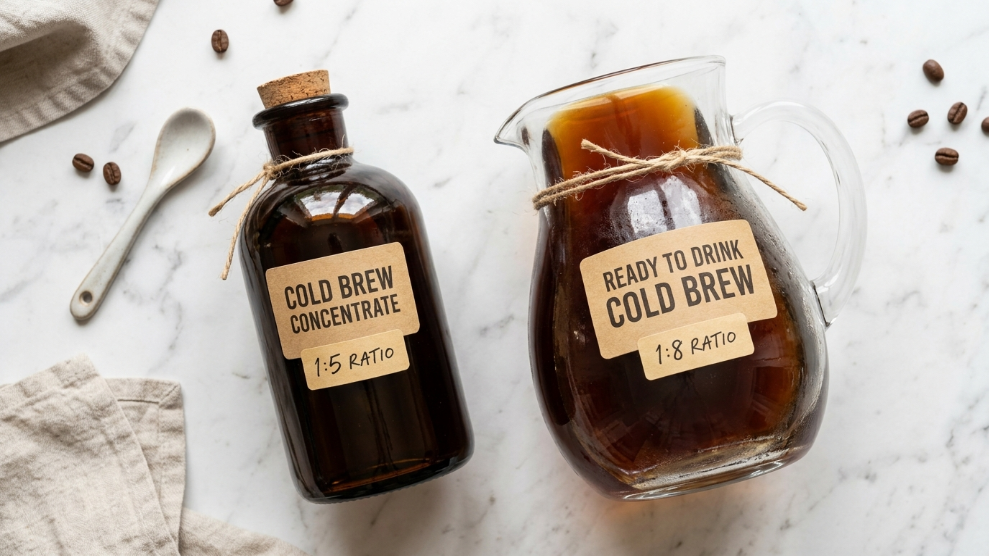
Cold Brew Concentrate: 1:5 ratio
For 500ml concentrate: 100g coffee, 500ml water. Steep 18 to 24 hours in the fridge. After straining, dilute 1:1 with water, milk, or plant milk before drinking. Do not drink concentrate undiluted. It contains 200 mg or more of caffeine per 250ml serving.
Cold Brew Ready-to-Drink: 1:8 ratio
For 800ml ready-to-drink: 100g coffee, 800ml water. Steep 16 to 20 hours in the fridge. After straining, pour over ice and drink directly without dilution.
Why cold brew uses much more coffee than hot methods: Cold water extracts caffeine and flavour compounds significantly more slowly than hot water. The high coffee dose compensates for the cold extraction efficiency, and the long steep time (12 to 24 hours) compensates for the slow extraction rate. Even with these compensations, cold brew produces a different flavour profile than hot-brewed coffee, not just a cold version of it.
For the complete cold brew brewing process: Cold Brew Coffee Complete Guide
For exact measurements at any batch size: Coffee to Water Ratio Calculator
Espresso
Recommended starting ratio: 1:2 (yield ratio)
18g coffee in, 36g espresso out. Shot time: 25 to 30 seconds.
Espresso uses a different ratio system to all other brew methods. Rather than measuring how much water goes into the machine, espresso uses a yield ratio the relationship between the dry coffee dose going in (the puck weight) and the liquid espresso coming out (the yield weight).
The three standard espresso yield ratios:
Ristretto (1:1.5): 18g coffee, 27g yield. Very short, concentrated, sweet. Preferred in some Italian traditions and used as the espresso base for flat whites in Australian cafes.
Normale (1:2): 18g coffee, 36g yield. The worldwide standard. Full extraction of sweet, balanced compounds. Starting point for all espresso dialling-in.
Lungo (1:3): 18g coffee, 54g yield. Extended, more bitter, thinner body. Common in Northern European countries. Lungo pods for pod machines mimic this profile.
How to measure espresso yield: Place a cup on a kitchen scale before pulling the shot. Tare to zero. Pull the shot directly into the cup. The scale reads the exact yield weight when the pump stops.
Why espresso ratio matters more than most home brewers realise: Many home espresso setups use volumetric programming that stops the pump after a set amount of time or water volume. If the grind changes (new bag of beans, different roast level), the extraction dynamics change but the machine still stops at the same point. Weighing the yield tells you whether the shot actually produced the intended ratio, regardless of what the machine’s programming says.
Moka Pot
Recommended ratio: Fill the basket fully, water to the valve
The moka pot is the one brew method that does not allow flexible ratio adjustment. The basket must be filled level with ground coffee and the boiler must be filled with water to just below the safety valve. Overfilling or underfilling either chamber produces unsafe pressure or extraction problems.
The ratio that results from correct moka pot filling is approximately 1:7, which produces a concentrated coffee that is stronger than drip but weaker than true espresso.
Important moka pot note: Moka pot does not produce espresso despite being commonly called “stovetop espresso.” It brews at approximately 1.5 to 2 bars of pressure, significantly below the 9 bars required for true espresso. The resulting coffee is excellent in its own right, but espresso ratios and techniques do not apply.
Turkish Coffee
Recommended ratio: 1:10 to 1:12
For one small cup (80ml serving): 7 to 8g of extra-fine ground coffee with 80 to 100ml of water.
Turkish coffee is made in a cezve (also called ibrik) by bringing the coffee-water mixture to a gentle boil, typically twice or three times. The grounds are never filtered out and settle to the bottom of the cup.
Because Turkish coffee is consumed in very small volumes (60 to 80ml per serving), even at 1:10 the total caffeine per serving is relatively low. For caffeine content comparison across all methods: Caffeine Content in Every Coffee Type
The Complete Ratio Quick Reference Table
| Brew Method | Starting Ratio | Coffee for 250ml | Coffee for 500ml | Strength Range |
|---|---|---|---|---|
| Pour-Over (V60, Kalita) | 1:16 | 16g | 31g | 1:14 to 1:18 |
| Chemex | 1:17 | 15g | 29g | 1:15 to 1:18 |
| AeroPress (standard) | 1:15 | 17g | 33g | 1:6 to 1:18 |
| French Press / Cafetière | 1:15 | 17g | 33g | 1:12 to 1:17 |
| Drip / Filter machine | 1:17 | 15g | 29g | 1:15 to 1:20 |
| Cold Brew concentrate | 1:5 | 50g | 100g | 1:4 to 1:6 |
| Cold Brew ready-to-drink | 1:8 | 31g | 63g | 1:7 to 1:12 |
| Espresso (yield ratio) | 1:2 yield | 18g in, 36g out | N/A | 1:1.5 to 1:3 |
| Moka Pot | Fill basket | N/A | N/A | Not adjustable |
| Turkish Coffee | 1:10 | 25g per 250ml | N/A | 1:8 to 1:12 |
How to Adjust Your Ratio Based on Taste
The ratio is your primary tool for controlling coffee strength. Here is how to read your cup’s feedback and adjust correctly.
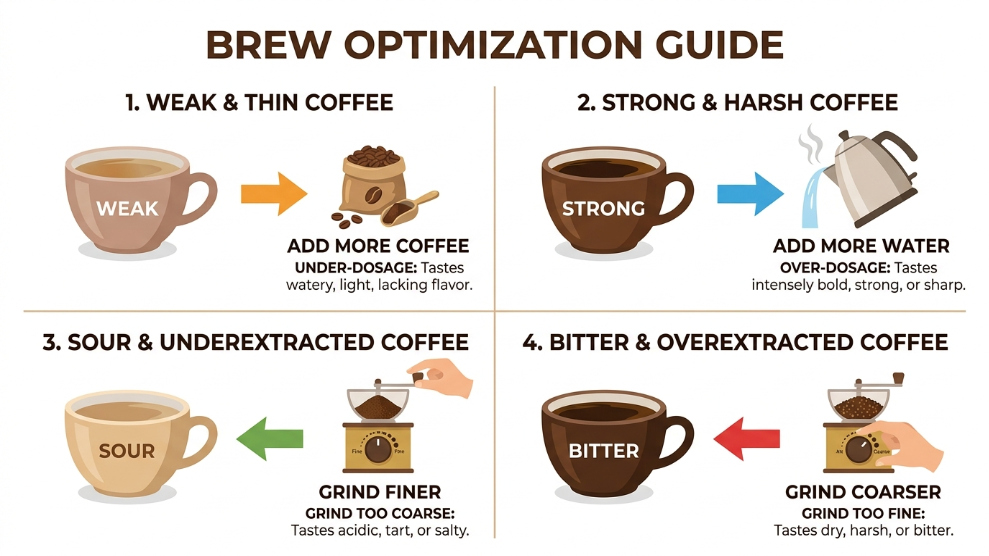
If your cup tastes weak or watery: The ratio has too much water relative to coffee. Use more coffee. Move from 1:17 to 1:15 by adding 2g of coffee while keeping the same water amount.
If your cup tastes too strong or intense: The ratio has too much coffee relative to water. Use more water. Move from 1:15 to 1:17 by increasing water while keeping the same coffee dose.
If your cup tastes sour and sharp despite correct strength: The problem is under-extraction, not ratio. Sour espresso or pour-over usually means water moved through the grounds too quickly. Grind finer before changing the ratio. Full guide: Why Does My Espresso Taste Sour?
If your cup tastes bitter despite correct strength: The problem is over-extraction. Grind coarser before changing the ratio. Very dark roasts brewed at high ratios are the most common cause.
The one-variable rule: When troubleshooting, change one thing at a time. If you adjust both the ratio and the grind in the same brew, you cannot identify which change fixed or worsened the problem. Adjust ratio first if strength is wrong. Adjust grind first if sourness or bitterness is the issue.
Tablespoon Guide for Those Without a Scale
A scale is strongly recommended for consistent results. However, if you are brewing without one, these are reliable starting approximations:
| Brew Method | Per 240ml Cup | Per 480ml Mug |
|---|---|---|
| Pour-Over | 2.5 tablespoons | 5 tablespoons |
| French Press / Cafetière | 2.5 tablespoons | 5 tablespoons |
| Drip Machine | 2 tablespoons | 4 tablespoons |
| AeroPress | 2.5 tablespoons | N/A (AeroPress is single cup) |
| Instant Coffee | 1 heaped teaspoon | 2 heaped teaspoons |
Important disclaimer: Tablespoon measurements vary by 20 to 30% depending on grind size and how loosely or tightly the grounds are packed. Use these as rough guides only. A basic kitchen scale costs less than a bag of specialty coffee and immediately removes this variable from your brewing.
How Grind Size Affects Your Ratio
The ratio and the grind size work together. Changing one affects the result that the other produces.
Finer grind with the same ratio: More surface area, faster extraction. The result is stronger-tasting coffee than the ratio alone would suggest because more compounds extract per unit of time.
Coarser grind with the same ratio: Less surface area, slower extraction. The result is weaker-tasting coffee than the ratio alone would suggest.
This is why changing the ratio does not fix a sourness or bitterness problem caused by grind size. If grounds are too coarse for the method, increasing the dose (changing the ratio) makes the cup stronger but still sour. The correct fix is to change the grind to match the method, then use the ratio to dial in strength.
For grind size by method: Coffee Grind Size Chart
For the right grinder to achieve consistent grind size: Best Coffee Grinders 2026
Ratio and Water Quality
Water quality affects how effectively a given ratio extracts. This is why the same ratio with the same beans can produce different results in London versus Glasgow.
Hard water (high mineral content, common in London and South East England) reduces extraction efficiency. The ratio that tastes balanced with soft water may taste flat or sour with very hard water because the minerals partially block extraction. Using a water filter or moving slightly to a tighter ratio (more coffee, same water) partially compensates.
Very soft water (common in Scotland, Wales, and the North West of England) can over-extract, making the same ratio taste more intense and sometimes more bitter than it would with moderately mineralised water.
Full guide to UK water and coffee: Hard Water and Coffee: UK Guide
Frequently Asked Questions
What is the standard coffee to water ratio?
There is no single universal standard because the correct ratio varies by brew method. The Specialty Coffee Association’s Golden Cup standard for filter and drip coffee is 1:18 (55g per litre). Pour-over starts at 1:16. Cold brew concentrate uses 1:5. Espresso uses a 1:2 yield ratio. Each method has a different starting point for good reason.
Is 1:15 or 1:16 better for pour-over?
Both are within the acceptable range. 1:15 produces a slightly more intense, full-bodied cup. 1:16 produces a more balanced cup that is often a better starting point for new beans or unfamiliar roast levels. Start at 1:16, taste the result, and move to 1:15 if you want more body and intensity.
How do I measure the right amount of coffee without a scale?
As a rough approximation, use 2 to 2.5 tablespoons of medium-ground coffee per 240ml of water for pour-over, French press, and drip coffee. This approximates a 1:15 to 1:17 ratio depending on grind size and how the spoon is filled. For consistent results, a kitchen scale measuring to 1 gram is the only reliable solution.
Does the ratio change for dark roast vs light roast coffee?
Slightly. Light roast beans are denser and contain marginally more caffeine per gram, so some brewers use a slightly lower dose (1:17 instead of 1:16) for light roasts. Darker roasts lose density in the roasting process, and some brewers use a slightly tighter ratio (1:15) to compensate for the faster extraction of dark roast compounds. In practice, starting at 1:16 for both and adjusting based on taste is a simpler approach.
What ratio should I use for a Nespresso or pod machine?
Pod machines use pre-dosed pods and do not allow ratio adjustment. The pod contains a fixed amount of coffee and the machine uses a fixed amount of water per pod size. The only adjustment available is choosing a smaller or larger cup size button on the machine, which changes how much water flows through the same pod and therefore changes the extraction and effective ratio.
What is the golden ratio for coffee?
The term golden ratio in coffee refers to the SCA’s Golden Cup standard of approximately 1:17 to 1:18 for filter and drip coffee. Some sources describe 1:16 as the golden ratio for all methods, but this is an oversimplification. Each brew method has its own optimal starting ratio range. Use the method-specific starting points in this guide rather than a single universal number.
Summary: Ratios at a Glance
The most important numbers from this guide:
Pour-over: 1:16. French press and cafetière: 1:15. Drip machine: 1:17 to 1:18. AeroPress: 1:15. Cold brew concentrate: 1:5 (dilute before drinking). Cold brew ready-to-drink: 1:8. Espresso yield ratio: 1:2. Turkish coffee: 1:10.
For exact gram amounts at any volume, use the interactive calculator: Coffee to Water Ratio Calculator
Sources used for this article: Specialty Coffee Association Brewing Standards and Golden Cup / USDA FoodData Central World Brewers Cup competition protocols pour-over technique reference

Munir Ahmed is the founder of Coffee Craft Guide, dedicated to building the most thorough and honest coffee resource for home brewers worldwide. Combining SCA brewing standards with deep-dive research across global coffee communities (like r/espresso and Home-Barista) and thousands of verified reviews, Munir and his team deliver data-backed, expert coffee insights you can trust.