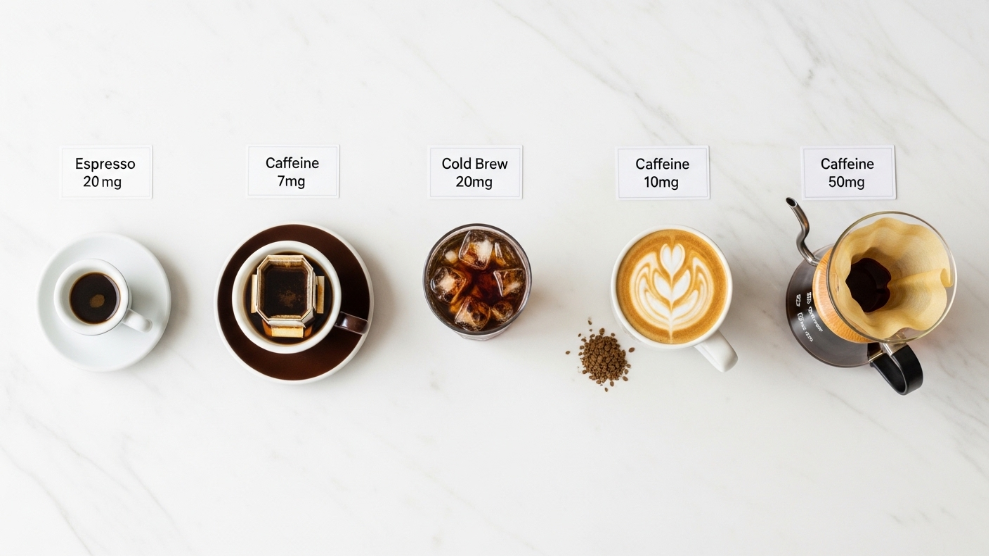
Most people significantly underestimate the caffeine in their cold brew and overestimate the caffeine in their espresso. A single espresso shot contains 63 mg of caffeine. A standard 12oz glass of cold brew contains 150 to 250 mg. If you have been choosing espresso over drip coffee to reduce your caffeine intake, you have been making the opposite of the correct decision.
This guide covers exact caffeine amounts for every major coffee type, based on data from the USDA FoodData Central database, the FDA’s caffeine analysis, and verified brand nutrition panels. All figures are averages from real measurements, not estimates.
Table of Contents
How We Sourced These Numbers
Every caffeine figure in this article is traced to one of three primary sources:
USDA FoodData Central: The United States Department of Agriculture maintains a comprehensive nutritional database that includes verified caffeine measurements for coffee and tea. These figures are the most widely cited in clinical and nutritional research.
FDA Caffeine Analysis: The US Food and Drug Administration publishes caffeine content data used to inform the 400 mg/day safe limit guideline.
Verified brand nutrition panels: For branded products such as Nespresso, Starbucks, and Keurig, we used official nutritional information published on their websites.
Caffeine content in real coffee varies. Factors including bean variety, roast level, grind size, water temperature, brew time, and individual plant genetics all affect the final caffeine amount. The figures below are verified averages. Your individual cup may be 15 to 30% higher or lower.
☕ Free Caffeine Tools
Want your personal safe limit? Our Caffeine Calculator works it out from your body weight, and the Caffeine Half-Life Calculator shows when caffeine leaves your system before bed.
Quick Reference: Caffeine by Coffee Type
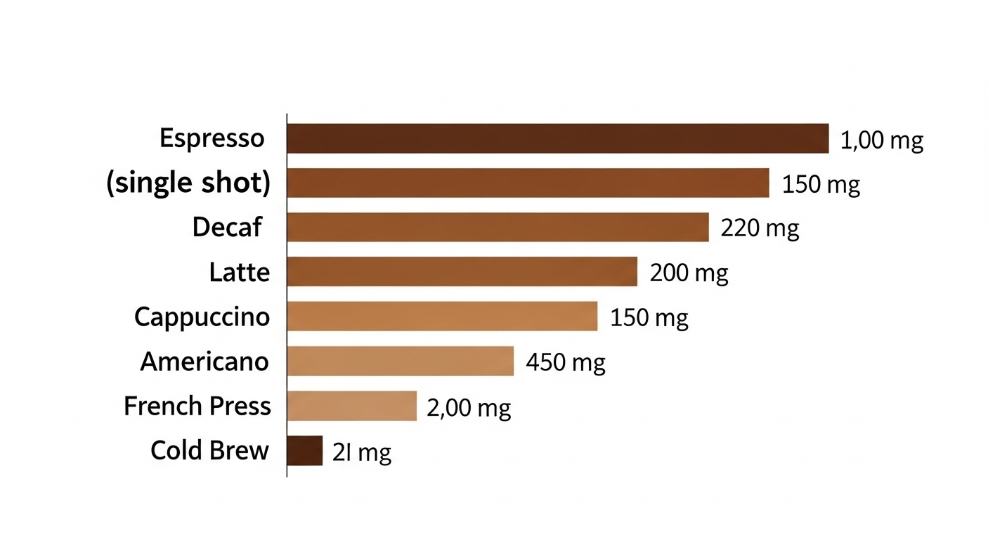
| Coffee Type | Serving Size | Caffeine (average) | Caffeine Range |
|---|---|---|---|
| Decaf coffee | 240ml (8oz) | 7 mg | 2 to 15 mg |
| Instant coffee | 240ml (8oz) | 63 mg | 30 to 90 mg |
| Espresso, single shot | 30ml (1oz) | 63 mg | 47 to 75 mg |
| Espresso, double shot | 60ml (2oz) | 125 mg | 94 to 150 mg |
| Drip / Filter coffee | 240ml (8oz) | 95 mg | 70 to 140 mg |
| Pour-Over coffee | 240ml (8oz) | 110 mg | 80 to 150 mg |
| French Press / Cafetière | 240ml (8oz) | 88 mg | 70 to 110 mg |
| Americano (double shot) | 240ml (8oz) | 125 mg | 100 to 150 mg |
| Flat White (2 shots) | 150ml | 125 mg | 100 to 150 mg |
| Latte (2 shots) | 240ml | 125 mg | 100 to 150 mg |
| Cappuccino (1 shot) | 180ml | 63 mg | 47 to 75 mg |
| Nespresso Original pod | 40ml | 75 mg | 60 to 90 mg |
| Nespresso Vertuo Espresso | 40ml | 75 mg | 60 to 90 mg |
| Nespresso Vertuo Alto | 414ml | 170 mg | 130 to 200 mg |
| Cold Brew, ready-to-drink | 240ml (8oz) | 165 mg | 130 to 200 mg |
| Cold Brew, concentrate | 60ml | 200 mg | 160 to 250 mg |
| Black tea | 240ml (8oz) | 47 mg | 25 to 65 mg |
| Green tea | 240ml (8oz) | 28 mg | 15 to 45 mg |
Source: USDA FoodData Central, FDA, brand nutrition panels.
Use our interactive Daily Caffeine Calculator to track your total daily intake across multiple drinks.
The Biggest Caffeine Misconception in Coffee
Before the breakdown by type, one fact that surprises almost everyone:
A single espresso shot contains less caffeine than a full cup of drip coffee.
Single espresso shot: 63 mg in 30ml. Drip coffee: 95 mg in 240ml. Despite espresso being far more concentrated per millilitre, the small serving size means the total caffeine per cup is lower.
According to USDA FoodData Central data, espresso contains approximately 212 mg per 100ml while brewed coffee contains about 60 to 70 mg per 100ml but espresso is not stronger per serving. An 8oz cup of drip coffee has about 95 mg compared to 63 mg in a single 1oz shot of espresso.
This matters practically. If you order a double espresso in a UK cafe, you are getting 125 mg. If you order a large filter coffee in that same cafe, you may be getting 150 mg or more depending on the brewing ratio. The espresso is not the high-caffeine choice in that scenario.
Caffeine in Espresso and Espresso Based Drinks
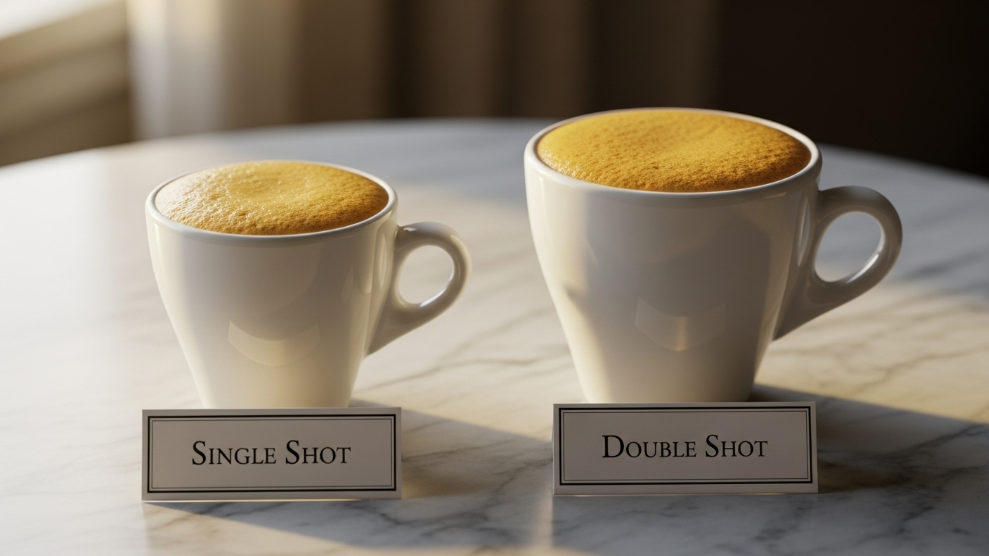
Single shot espresso (30ml): 63 mg average. Range of 47 to 75 mg based on USDA data from 97 samples.
Double shot espresso (60ml): 125 mg average. This is the standard serving in most cafes in the USA, UK, Australia, and New Zealand when you order “an espresso” or “a double.”
Ristretto (shorter shot, 20ml): Approximately 50 to 70 mg. Less water passes through the same dose of coffee, so slightly fewer total compounds are extracted. Counterintuitively, a ristretto has similar or marginally less caffeine than a normale despite being more concentrated.
Lungo (longer shot, 60 to 90ml): 80 to 120 mg. More water extracts more caffeine from the same dose.
Americano (double shot plus hot water, 240ml): 125 mg. Same caffeine as a double shot because the added water does not change the espresso content.
Flat White (2 shots plus steamed milk, 150ml): 125 mg. Standard in Australian and New Zealand cafes where a flat white is typically two ristretto shots. The milk adds no caffeine.
Latte (2 shots plus steamed milk, 240ml): 125 mg. Same espresso base as a flat white, more milk.
Cappuccino (typically 1 shot in standard UK serving, 180ml): 63 mg. Note: Australian and American cappuccinos are often double shot, giving 125 mg.
Macchiato (traditional, 1 shot, 30ml): 63 mg. Starbucks “Caramel Macchiato” is a different drink with 2 to 3 shots and 150 to 225 mg.
Caffeine in Drip and Filter Coffee
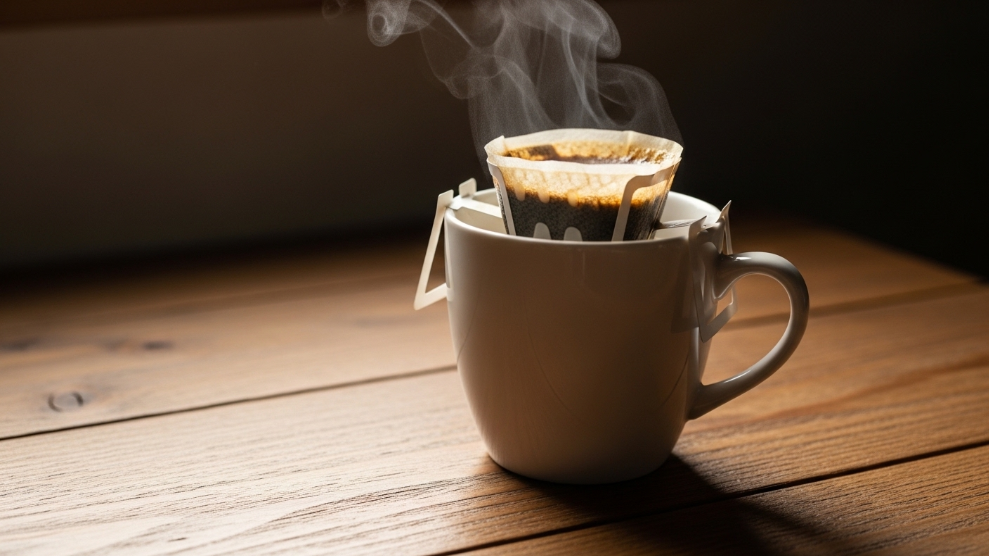
Standard drip coffee (240ml/8oz): 95 mg average. Range of 70 to 140 mg.
The wide range reflects the variation in home brewing. More coffee per litre, longer contact time, or hotter water all increase caffeine extraction. The Specialty Coffee Association Golden Cup standard recommends 55g of coffee per litre of water (1:18 ratio), which produces approximately 95 mg per 240ml serving.
Keurig K-Cup (240ml): 75 to 150 mg depending on the brand. Standard K-Cups average around 100 mg. Death Wish Coffee K-Cups contain approximately 300 mg per cup, making them among the highest-caffeine consumer coffee products available.
Starbucks comparison: A Starbucks Tall (12oz) Blonde Roast drip coffee contains 270 mg. A Venti (20oz) Blonde Roast contains 475 mg, which exceeds the FDA’s 400 mg/day guideline in a single drink for healthy adults.
Caffeine in Pour Over Coffee
Pour-Over V60, Kalita Wave (240ml): 100 to 150 mg on average.
Pour-over typically produces slightly higher caffeine than standard drip coffee from the same beans because the slow, controlled pour maintains more consistent contact time and temperature throughout extraction. A standard 8oz cup of drip brewed coffee contains approximately 95 mg on average, with a range of 70 to 140 mg depending on bean, grind, and brew time. Pour-over’s more controlled extraction sits toward the upper end of that range.
The ratio also matters. Most pour-over guides recommend 1:16 (1g coffee per 16ml water), which is slightly stronger than the SCA’s 1:18 drip recommendation and produces accordingly more caffeine per cup.
See our full brewing guide: Pour-Over Coffee Complete Guide
Caffeine in Cold Brew The Highest of Any Method
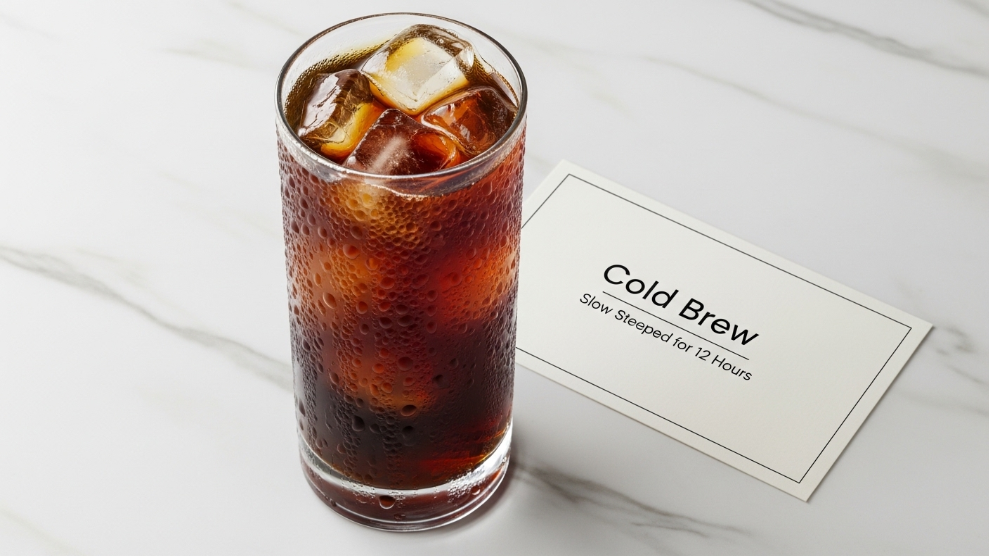
Cold brew consistently contains the highest caffeine of any home-brewed coffee method, and most people significantly underestimate how much they are drinking.
Cold brew runs 150 to 250 mg per 12oz serving. The higher caffeine comes from the high coffee-to-water ratio used during brewing, not from the cold temperature itself.
Why cold brew is so high in caffeine:
Cold brew uses a coffee-to-water ratio of 1:5 for concentrate and 1:8 for ready-to-drink. Standard drip coffee uses 1:17 to 1:18. The cold brew ratio puts 2 to 3 times more coffee into the same volume of water. The 12 to 24 hour steep time then extracts a high proportion of the available caffeine from that concentrated dose.
Ready-to-drink cold brew (240ml/8oz): 155 to 200 mg average.
Cold brew concentrate (60ml, undiluted): 200 mg or more. This is why concentrate should never be consumed undiluted. It is designed to be diluted 1:1 with water or milk before drinking.
Stumptown Cold Brew (10.5oz bottle): 295 mg per bottle, verified from official nutrition panel.
Important: If you drink cold brew thinking it is a lower-stimulant alternative to espresso, you are consuming significantly more caffeine than you likely intend. A 240ml glass of cold brew equals approximately two to three double espresso shots in caffeine content.
Track your cold brew caffeine intake: Daily Caffeine Calculator
Full cold brew brewing guide: Cold Brew Coffee Complete Guide
Caffeine in Instant Coffee
Instant coffee (240ml/8oz): 63 mg average. Range of 30 to 90 mg.
Instant coffee consistently contains less caffeine than brewed coffee from the same volume of water. This is because the manufacturing process partially extracts caffeine from the beans, and the resulting soluble granules have a lower caffeine concentration per gram than fresh ground coffee.
Instant coffee is the lowest-caffeine hot coffee option after decaf. For buyers who want to reduce their caffeine intake without switching to decaf, switching from drip to instant reduces caffeine intake by approximately 30 to 40% per cup.
Caffeine in Nespresso Pods
Nespresso pods vary significantly in caffeine content depending on the line and pod size. This is one of the most frequently misunderstood areas of coffee caffeine.
Nespresso Original Line (all sizes, 40ml espresso): 60 to 90 mg per pod. The small serving size and espresso extraction method keeps total caffeine moderate.
Nespresso Vertuo Line:
| Vertuo Pod Size | Volume | Caffeine |
|---|---|---|
| Espresso | 40ml | 60 to 90 mg |
| Double Espresso | 80ml | 120 to 200 mg |
| Gran Lungo | 150ml | 120 to 200 mg |
| Mug | 230ml | 130 to 200 mg |
| Alto | 414ml | 130 to 200 mg |
The key Vertuo insight: a 414ml Alto pod contains similar total caffeine (130 to 200 mg) to a 40ml espresso pod (60 to 90 mg) despite having nearly 10 times the volume. Nespresso uses different amounts of coffee per pod for each size. This is why the Alto, despite looking like a large mug of coffee, is not significantly higher in caffeine than an espresso pod.
Caffeine in Tea vs Coffee
| Tea Type | Serving (240ml) | Caffeine |
|---|---|---|
| Black tea | 240ml | 47 mg |
| Oolong tea | 240ml | 37 mg |
| Green tea | 240ml | 28 mg |
| White tea | 240ml | 15 to 30 mg |
| Matcha (1 tsp in 60ml) | 60ml | 70 mg |
| Herbal tea | 240ml | 0 mg (caffeine-free) |
Tea consistently contains less caffeine than coffee in equivalent serving sizes. Matcha is the exception because it uses the entire ground leaf rather than steeping and discarding it, producing higher caffeine per small serving than other teas.
Note for UK readers: The UK’s tea-drinking culture means that many people consume 3 to 6 cups of black tea per day. At 47 mg per cup, 5 cups equals 235 mg, which is approaching the 400 mg daily limit before any coffee is included.
Does Decaf Coffee Have Caffeine?
Yes. This is one of the most widely misunderstood facts about coffee.
According to the 2019 USDA FoodData Central Database, decaf coffee contains 2.4 mg per 8oz serving on average. Other sources put the range at 2 to 15 mg per cup, depending on the decaffeination method and bean variety.
Decaffeination removes approximately 97% of caffeine, not 100%. For most people, 2 to 15 mg is completely inconsequential. However, for people with severe caffeine sensitivity, during pregnancy, or for those who have been medically advised to eliminate caffeine entirely, multiple cups of decaf per day can accumulate to meaningful amounts.
The decaffeination method matters. Swiss Water Process decaf typically retains the least caffeine (2 to 5 mg per cup). Solvent-based decaf may retain slightly more.
Light Roast vs Dark Roast: Which Has More Caffeine?
The persistent myth is that dark roast coffee is stronger and therefore higher in caffeine. The truth is that dark roast has slightly less caffeine than light roast, not more. Roasting burns off a small amount of caffeine, so light roast retains marginally more. The difference is roughly 5 to 10% and largely negligible in practice.
The reason dark roast tastes “stronger” is because roasting develops more bitter and bold flavour compounds, not because it has more caffeine. A light roast Ethiopian Yirgacheffe and a dark roast French Roast made from the same beans and brewed at the same ratio will have nearly identical caffeine content despite tasting dramatically different.
The practical takeaway: if you are switching from dark to light roast to reduce caffeine, you will not reduce your intake meaningfully. Switch to instant or decaf for a genuine reduction.
Arabica vs Robusta: The Bean Difference
Arabica beans make up approximately 60% of global coffee production. They are the standard in specialty coffee. Arabica beans contain approximately 1.2 to 1.5% caffeine by dry weight.
Robusta beans contain approximately 2.2 to 2.7% caffeine by dry weight roughly double the caffeine of Arabica for the same amount of coffee.
Most specialty coffee and all coffee subscriptions in our Best Coffee Subscriptions 2026 guide use exclusively Arabica beans. Mass-market instant coffees often contain Robusta for cost reasons, which explains why some cheaper instant coffees actually have higher caffeine than specialty brewed coffee despite the lower brewing ratio.
Factors That Change Caffeine Content in Your Cup
Dose: The most direct factor. More coffee per litre means more caffeine. Using 60g per litre (1:16) instead of 55g (1:18) increases caffeine by approximately 9%.
Grind size: Finer grounds have more surface area and extract caffeine more efficiently in the same brew time. An espresso grind extracts more caffeine per gram of coffee than a coarse French press grind.
Water temperature: Hotter water extracts caffeine more efficiently. Brewing at 96°C extracts marginally more caffeine than brewing at 90°C from the same coffee. Cold brew compensates for cold temperature with a much higher coffee dose and much longer steep time.
Brew time: Longer contact time between water and coffee extracts more caffeine. Cold brew’s 12 to 24 hour steep extracts far more than a 4-minute French press steep.
Bean variety: Robusta contains roughly double the caffeine of Arabica for the same weight of beans.
Roast level: Marginal effect. Light roast retains slightly more caffeine than dark roast but the difference is less than 10% and not practically significant.
Safe Daily Caffeine Limits
The FDA recommends a maximum of 400 mg of caffeine per day for healthy adults. In practical terms:
- 4 to 5 standard cups of drip coffee at 95 mg each
- 3 double espresso shots at 125 mg each
- 2 to 2.5 glasses of cold brew at 165 mg each
Pregnant and breastfeeding women: 200 mg maximum per day, recommended by the NHS, WHO, and American College of Obstetricians and Gynecologists.
Teens under 18: Under 100 mg per day recommended by Health Canada and the American Academy of Pediatrics.
Individuals with anxiety, heart conditions, or insomnia: Personal tolerance varies significantly. If you experience palpitations, anxiety, or disrupted sleep at intakes well below 400 mg, your personal threshold may be lower than the population average.
UK Caffeine Notes
UK adults drink an average of 1.5 to 2.5 cups of coffee per day plus 2 to 4 cups of tea. This combination puts many UK adults between 200 and 350 mg per day before accounting for any additional caffeinated drinks.
The NHS caffeine guidance for adults mirrors the FDA at approximately 400 mg per day. The NHS specifically notes that energy drinks and pre-workout supplements should be factored into daily totals alongside tea and coffee.
For UK buyers using Nespresso or Dolce Gusto pod machines: pod size varies significantly in caffeine as shown in the Nespresso table above. Verify the specific pod you are using against the manufacturer’s nutrition panel.
Australia and New Zealand Caffeine Notes
Australian and New Zealand coffee culture is predominantly espresso-based. The standard morning coffee order is a flat white or latte with two espresso shots, providing 125 mg of caffeine. This is moderate compared to large American drip coffees or cold brew servings.
Food Standards Australia New Zealand (FSANZ) mirrors the international standard of 400 mg per day as the guideline for healthy adults and 200 mg for pregnant women.
Frequently Asked Questions
Does espresso have more caffeine than coffee?
Per millilitre, yes. Per serving, no. A 30ml single espresso has 63 mg. A 240ml cup of drip coffee has 95 mg. If you are comparing a double espresso (125 mg) to a large drip coffee (140 mg or more), they are similar. The confusion arises from comparing concentration to total amount.
How much caffeine is in a Nespresso pod?
It depends on the line and pod size. Nespresso Original and Vertuo espresso pods contain 60 to 90 mg. Vertuo larger sizes (Gran Lungo, Mug, Alto) contain 120 to 200 mg despite looking like a full mug of coffee, because Nespresso uses different amounts of coffee per pod for each size.
Is cold brew safe to drink every day?
At a 240ml serving of ready-to-drink cold brew (165 mg), it is within the 400 mg daily limit and safe for healthy adults who are not pregnant. Two large cold brew servings per day approaches the daily limit. Drinking undiluted cold brew concentrate in full cup volumes can easily exceed 400 mg in one serving and is not recommended.
Does green tea have less caffeine than coffee?
Yes, significantly. Green tea averages 28 mg per 240ml cup. A standard cup of drip coffee has 95 mg. However, drinking 4 to 5 cups of green tea over a day can equal one cup of drip coffee in total caffeine.
Is there a coffee with essentially no caffeine?
Herbal teas have zero caffeine. Among actual coffee products, Swiss Water Process decaf is the lowest practical option at 2 to 5 mg per cup. This is 97%+ lower than regular drip coffee and negligible for all but the most extreme caffeine sensitivity cases.
Does the Specialty Coffee Association have a caffeine standard?
The SCA does not set caffeine content standards as they are determined by bean variety and preparation. The SCA does set brewing standards for extraction yield and water quality that indirectly affect caffeine content by defining the ratio and temperature used in brewing.
Summary: Caffeine From Lowest to Highest
- Decaf coffee: 2 to 15 mg
- Herbal tea: 0 mg
- Green tea: 28 mg
- White tea: 15 to 30 mg
- Black tea: 47 mg
- Instant coffee: 30 to 90 mg
- Espresso single shot: 63 mg
- Cappuccino (1 shot): 63 mg
- French Press: 80 to 110 mg
- Drip coffee: 95 to 140 mg
- Pour-Over: 100 to 150 mg
- Espresso double shot / Americano / Flat White / Latte: 125 mg
- Cold Brew ready-to-drink: 155 to 200 mg
- Cold Brew concentrate undiluted: 200 mg or more
Track your exact total today: Daily Caffeine Calculator
Sources used for this article: USDA FoodData Central / FDA Caffeine Guidance for Consumers / IFIC Caffeine Calculator / MyCaffeineCalculator
Munir Ahmed is the founder of Coffee Craft Guide, dedicated to building the most thorough and honest coffee resource for home brewers worldwide. Combining SCA brewing standards with deep-dive research across global coffee communities (like r/espresso and Home-Barista) and thousands of verified reviews, Munir and his team deliver data-backed, expert coffee insights you can trust.