The word specialty is used freely in coffee marketing. Almost every bag on a supermarket shelf claims some form of premium quality. But specialty coffee has a precise definition, set by the Specialty Coffee Association, and it is more specific than most buyers realise.
Specialty coffee is coffee that scores 80 points or more out of 100 on a standardised cupping protocol assessed by certified professional tasters. Only an estimated 2 to 3 percent of global coffee production qualifies. The majority of coffee consumed globally, including most well-known brand-name coffees, does not meet this standard.
This guide explains exactly what that score means, how coffee earns it, what single origin coffee actually is, how the supply chain differs from commercial coffee, and whether the price premium is justified.
Table of Contents
The Official Definition
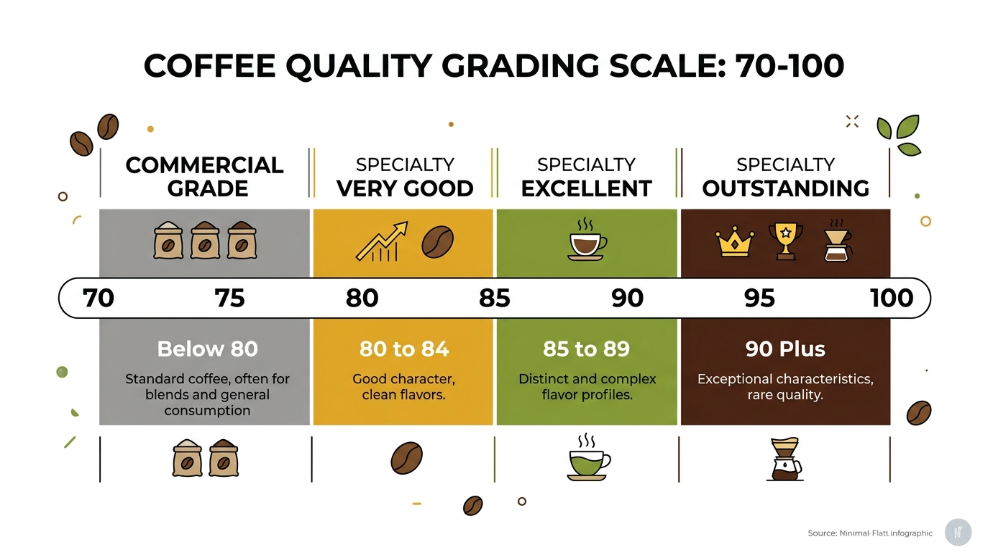
The Specialty Coffee Association defines specialty coffee as coffee that achieves a cupping score of 80 points or above on the SCA’s 100-point cupping scale. Coffee scoring below 80 is classified as commercial grade or commodity coffee.
The cupping protocol is standardised, meaning it produces the same result regardless of where in the world it is performed. Certified Q Graders professional coffee tasters who have passed a rigorous 22-exam certification process run by the Coffee Quality Institute perform the assessments.
The 100-point score evaluates:
- Fragrance and aroma (the dry and wet smell of ground coffee)
- Flavour (the overall taste impression)
- Aftertaste (flavours that linger after swallowing)
- Acidity (the brightness or liveliness in the cup)
- Body (the texture and weight of the liquid)
- Balance (how harmoniously all attributes combine)
- Uniformity (consistency across multiple cups)
- Sweetness
- Cleanliness (absence of off-flavours)
- Overall impression
A score of 80 to 84 is “very good” specialty. A score of 85 to 89 is “excellent.” Scores of 90 and above are “outstanding” and are extremely rare, typically reserved for exceptional micro-lot and competition coffees.
Specialty Coffee vs Commercial Coffee: The Real Difference
The distinction between specialty and commercial coffee is not just about taste. It runs through the entire supply chain from the farm to your cup.
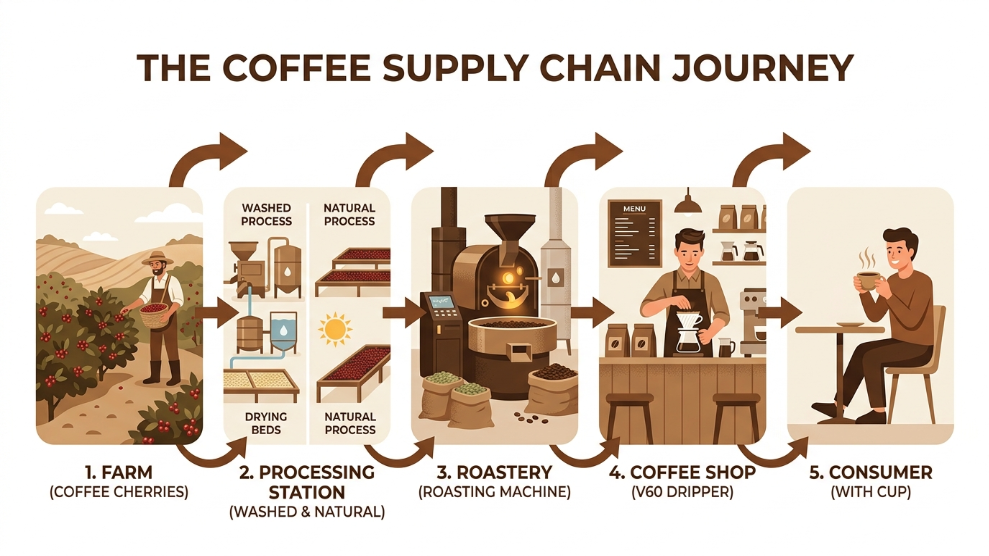
Commercial coffee supply chain: Commercial coffee aggregates beans from many farms across multiple countries into large blends. Traceability ends at the country level or blend description. The goal is consistency at scale: every bag of a commercial brand should taste similar regardless of the season, origin variation, or harvest quality. Commodity coffee prices are traded on global markets (the C price), and farmers receive payment based on commodity price regardless of quality.
Specialty coffee supply chain: Specialty coffee is traceable to a specific farm, cooperative, or region. The roaster typically knows exactly which farm the beans came from, who grew them, what processing method was used, and what the cupping score was. The price paid to the farmer is above the commodity price and often includes a direct trade premium. This economic relationship incentivises farmers to invest in quality.
The practical effect: specialty coffee reaches the consumer with documented quality, traceable origin, and freshness managed across the supply chain. Commercial coffee optimises for consistency and price.
What Single Origin Coffee Actually Means
Single origin is one of the most used and most misunderstood terms in specialty coffee. It means the coffee comes from one specific location rather than a blend of multiple origins. But the term encompasses several levels of specificity:
Country origin: Coffee described as “Ethiopian” or “Colombian” comes from one country but potentially from many different farms within it. This is the broadest level of single origin and the most common on commercial specialty bags.
Regional origin: “Ethiopian Yirgacheffe” or “Colombian Huila” specifies the region within the country. This is more specific and indicates a particular microclimate and growing condition. Most genuine specialty coffee is described at this level.
Single farm: Coffee from one specific farm, identified by name. This is the most traceable and often the most expensive level. “Finca La Palma” or “Hambela Estate” are examples of farm-specific lots.
Micro-lot: A specific section of a single farm, sometimes as small as a single plot harvested on a single day. Micro-lot coffees represent the peak of specialty traceability and price. World competition-level coffees are almost always micro-lots.
For buyers: country or regional single origin is the standard in most specialty subscriptions. See the Best Coffee Subscriptions 2026 guide for subscriptions that specify origin at the regional or farm level.
Coffee Processing Methods: Why They Matter to Flavour
After the coffee cherry is harvested, the fruit must be removed from the seed (the coffee bean). The method used to do this dramatically affects the flavour of the finished coffee.
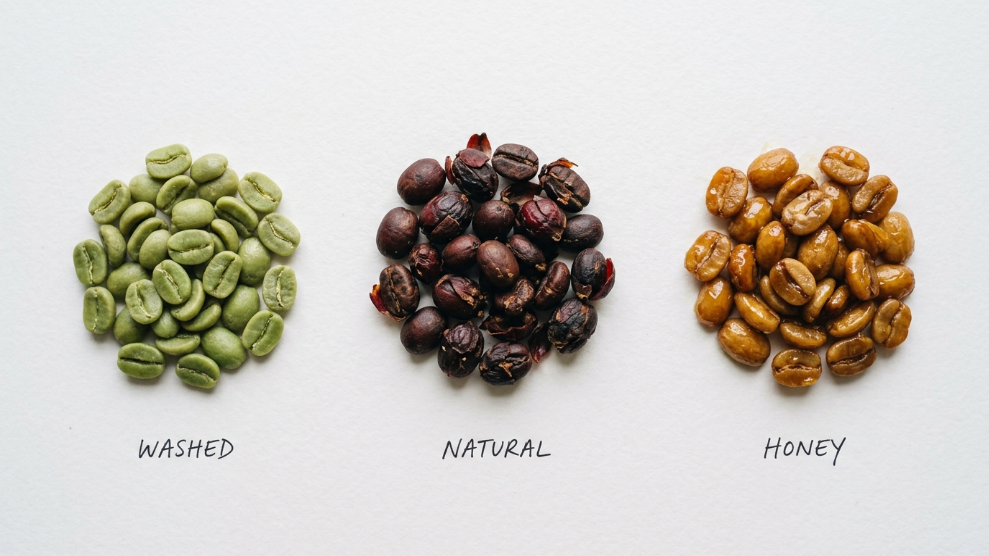
Washed processing (also called wet processing): The fruit is removed from the bean within 24 to 48 hours of harvesting, and the bean is dried with minimal contact with the fruit. Washed coffees tend to be clean, bright, and acidic, allowing the terroir and bean variety to express clearly. Ethiopian Yirgacheffe and Kenyan coffees are frequently washed processed.
Natural processing (also called dry processing): The whole coffee cherry is dried with the fruit intact, sometimes for 3 to 6 weeks. The bean absorbs sugars and fermentation compounds from the drying fruit. Natural processed coffees tend to be fruity, wine-like, and full-bodied. Ethiopian Harrar and many Brazilian natural coffees use this method.
Honey processing: A middle ground between washed and natural. The fruit skin is removed but varying amounts of the sticky mucilage layer are left on the bean during drying. Yellow honey (less mucilage) produces a lighter fruit character. Red and black honey (more mucilage, longer drying) produce more fruit-forward flavours approaching natural processing. Common in Costa Rica and Guatemala.
Anaerobic fermentation: A newer and increasingly common specialty processing where the coffee ferments in sealed tanks with no oxygen before drying. This produces distinctive fruity, sometimes funky, complex flavours. Many competition-winning coffees use anaerobic processing.
Understanding processing matters because the method on a bag tells you significant information about the flavour you will experience before tasting. Washed Ethiopian light roast in a pour-over tastes completely different from a natural Brazilian medium roast in the same brewer.
☕ Free Tools & Printables
Brewing well starts with the right grind, see the Coffee Grind Size Chart. Free downloads: name what you taste with the Coffee Flavor Wheel (PDF) and record it with the Tasting Notes Template (PDF).
Specialty Coffee Producing Regions and Their Flavour Profiles
Coffee grows in the “Bean Belt” a band between the Tropics of Cancer and Capricorn where temperature, altitude, and rainfall create conditions for coffee cultivation. Within this belt, each major producing region has characteristic flavour tendencies.
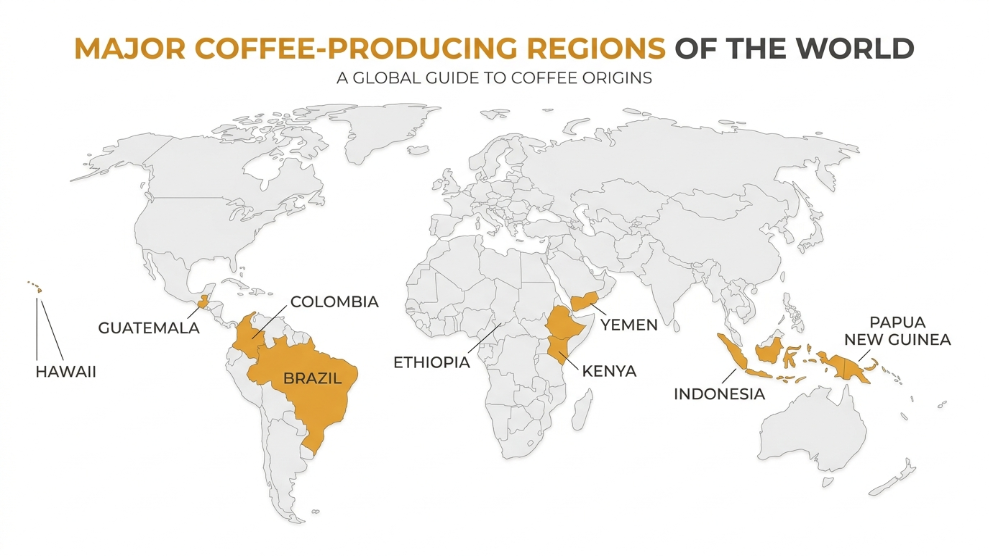
Ethiopia Widely considered the birthplace of coffee Flavour profile: Floral, berry, citrus, tea-like. Distinctive jasmine and blueberry notes in Yirgacheffe. Stone fruit and berry in Sidamo and Harrar. Why it is distinctive: Ethiopia has an enormous diversity of indigenous coffee varieties that exist nowhere else. Genetic coffee diversity in Ethiopia is unmatched globally. Best for: Pour-over and filter methods. Ethiopian coffees shine when brewed methods preserve aromatic clarity.
Kenya Flavour profile: Bright, complex, blackcurrant, tomato acidity, bold and structured. Why it is distinctive: Kenya uses a unique double-fermentation washed processing and grades by bean size (AA, AB, PB). The bold, bright acidity makes Kenyan coffee one of the most recognisable single origins globally. Best for: Pour-over, V60. The structured acidity requires higher brew temperatures (94 to 96°C).
Colombia Flavour profile: Balanced, caramel sweetness, red apple acidity, mild nuttiness. Why it is distinctive: Colombia’s topography creates many distinct microclimates at altitude. Colombian coffee is reliably balanced, making it one of the most popular specialty origins for everyday drinking. Best for: Pour-over, drip, and espresso. Colombian is one of the most versatile specialty origins.
Guatemala Flavour profile: Dark chocolate, brown spice, subtle fruit, medium-full body. Why it is distinctive: Antigua and Huehuetenango produce distinct regional profiles. Guatemalan coffee has become a staple of espresso blends for its chocolatey, body-forward character. Best for: Espresso, French press, cold brew. Excellent for cold brew at 1:8 ratio.
Brazil Flavour profile: Nutty, chocolate, low acidity, full body. Why it is distinctive: Brazil produces approximately 30 to 40% of the world’s coffee. Natural processing dominates, creating the sweet, nutty profile. Low acidity makes Brazilian coffee widely accessible. Best for: Espresso, cold brew, French press. Brazilian is the most common espresso blend base globally.
Hawaii (Kona) Flavour profile: Smooth, clean, mild sweetness, light acidity, slight nuttiness. Why it is distinctive: The volcanic soil of the Big Island’s Kona district creates a unique growing environment. Genuine 100% Kona is one of the most geographically protected coffees in the world. Best for: Drip, pour-over, French press. Kona is rarely used for espresso because its mild, smooth character is better suited to filter methods.
Yemen Flavour profile: Wine-like, exotic spice, dark fruit, complex fermented notes. Why it is distinctive: Yemen may be the oldest coffee-producing region after Ethiopia. The ancient heirloom varieties and traditional natural processing create a uniquely complex profile unlike any other origin. Best for: Pour-over or French press. Yemeni coffee is an experience for adventurous specialty drinkers.
What Is Third Wave Coffee?
Third wave coffee is a cultural and commercial movement within the specialty industry, not a formal certification. It refers to coffee treated as an artisanal agricultural product, similar to fine wine or craft beer, rather than a commodity.
First wave: Mass-market commercial coffee. The rise of Folgers, Maxwell House, and canned vacuum-packed coffees in the 20th century. The goal was consistent, affordable, widely available coffee.
Second wave: The rise of coffeehouse culture in the 1980s and 1990s. Starbucks, Costa, and Caffe Nero represent second wave. Espresso-based drinks, the cafe as a social space, and coffee as experience rather than utility.
Third wave: Starting in the early 2000s and now mainstream in specialty. Focus on origin traceability, farm relationships, processing transparency, light roasting to highlight rather than mask bean character, and skilled brewing technique. Blue Bottle, Intelligentsia, Stumptown, and thousands of independent specialty roasters represent third wave.
The term is now somewhat dated in specialty industry discussions, with some using “fourth wave” to describe data-driven, precision-focused brewing (specific extraction percentages, refractometer measurements, and algorithm-based recipe development).
How to Identify Genuine Specialty Coffee on a Bag
Not all bags claiming specialty are genuine. Here is what to look for on packaging:
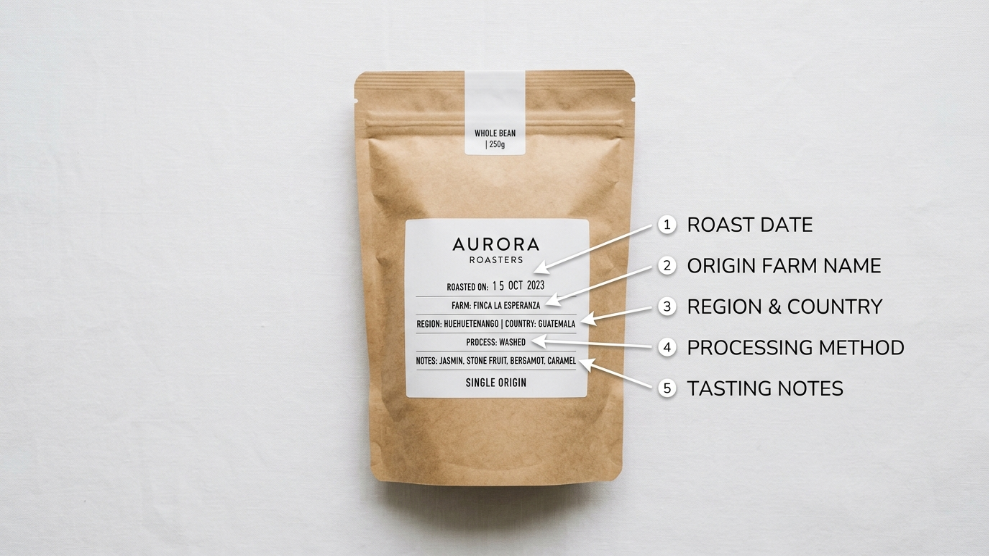
Roast date: Genuine specialty roasters always print the roast date, not a best-before or expiry date. You want beans within 3 to 21 days of the roast date for optimal flavour. Supermarket coffee rarely shows a roast date because the beans may be months old.
Specific origin: Look for a named region, farm, or cooperative. “Ethiopian Coffee” is minimal. “Ethiopian Yirgacheffe, Kochere Cooperative” is specific. “Single Estate, Finca El Injerto, Huehuetenango, Guatemala” is excellent specificity.
Processing method: The bag should state washed, natural, honey, or anaerobic. Commercial coffee never specifies processing.
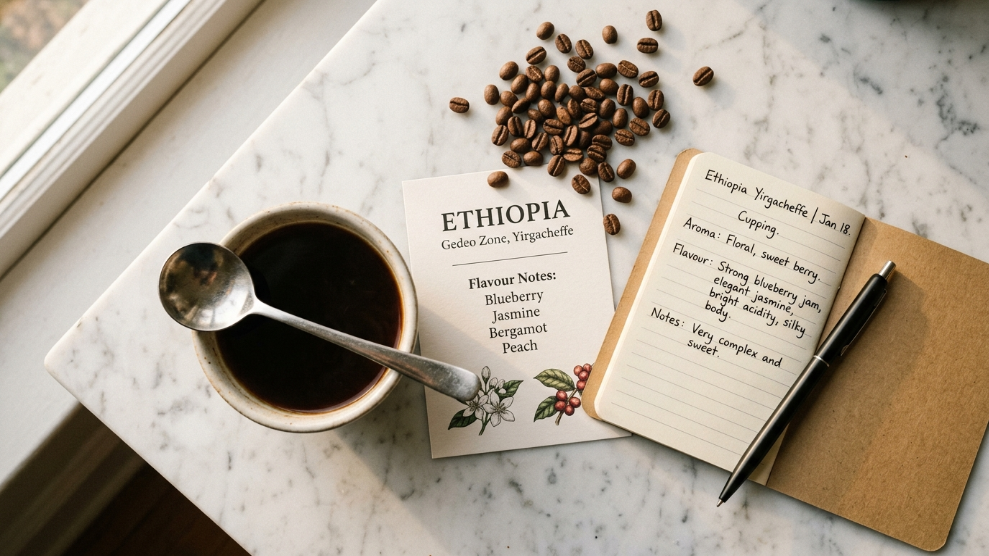
Tasting notes: Specific notes such as “blueberry, jasmine, bergamot” rather than generic “rich and smooth” indicate the roaster has cupped the coffee and identified specific characteristics.
SCA score: Some roasters print the cupping score on the bag. An 85-point score is genuinely excellent. Be sceptical of printed scores above 88 without verifiable sourcing.
Altitude: Many specialty bags print the growing altitude in metres above sea level. Coffee grown above 1,500 metres tends to develop more complex flavours due to slower maturation. Altitude below 1,000 metres typically produces lower-complexity coffee.
Specialty Coffee in the UK
The UK’s specialty coffee scene has grown significantly since the mid-2000s. London in particular has one of the most active third-wave specialty communities in the world, with a concentration of respected independent roasters including:
Monmouth Coffee (Borough Market and Covent Garden) one of the earliest and most respected specialty roasters in the UK, established in 1978 but an early adopter of direct trade relationships.
Square Mile Coffee Roasters founded by World Barista Championship participants, used as a benchmark by specialty professionals across Europe.
Origin Coffee Cornwall-based roaster with strong direct trade relationships and a growing presence across UK cafes and online.
Assembly Coffee Brixton-based, known for transparent sourcing and a curated single-origin selection.
For UK subscriptions that deliver specialty-grade single origins: Best Coffee Subscriptions 2026
Brewing guidance for getting the most from specialty beans: Pour-Over Coffee Complete Guide
Specialty Coffee in Australia and New Zealand
Melbourne is consistently ranked among the world’s leading cities for specialty coffee culture. The city’s independent cafe scene drove the development of the flat white as a distinct espresso-milk drink and established standards for espresso technique that influenced barista practice globally.
Australian and New Zealand specialty roasters with international reputations include:
Ona Coffee (Canberra) Australian baristas from Ona have won multiple World Barista Championship titles.
Campos Coffee (Sydney) one of the most established specialty roasters in Australia with direct farm relationships across multiple origins.
Five Senses Coffee (Perth and Melbourne) known for training programs and single-origin espresso.
Flight Coffee (Wellington, New Zealand) one of NZ’s most respected specialty roasters with a strong pour-over and filter focus.
The Australian and New Zealand specialty market is primarily espresso-focused compared to the filter-heavy orientation of Scandinavian and UK specialty scenes. Ethiopian and Colombian single origins are the most popular in both countries for both espresso and pour-over.
Is Specialty Coffee Worth the Higher Price?
Honest answer: it depends on how and where you brew it.
When specialty coffee is clearly worth it:
If you brew pour-over, V60, or AeroPress at home with a quality grinder and fresh water, specialty single-origin coffee produces a dramatically different cup from commercial supermarket coffee. The flavour clarity, complexity, and clean finish of a properly brewed specialty Ethiopian or Kenyan are genuinely not achievable with commodity beans regardless of brewing technique.
If you drink your coffee black or with minimal milk, you taste the coffee directly. Specialty beans make a clear difference.
If you use a coffee subscription to explore different origins and processing methods, specialty coffee provides an educational dimension that commercial coffee cannot.
When the price premium matters less:
If you drink espresso with steamed milk (lattes, flat whites), milk softens and masks many of the subtler aromatic compounds that justify specialty pricing. A good quality commercial espresso blend often produces similar results in milk-based drinks at lower cost.
If you brew with a drip machine that does not maintain optimal temperature, the machine’s limitations cap the quality of the extraction regardless of bean quality. The machine is the limiting factor, not the beans.
The practical recommendation: Buy specialty beans from a reputable roaster with a clear roast date, matched to your preferred brew method, and brewed with a quality grinder and fresh water. In that combination, the price premium delivers a genuinely better cup.
Frequently Asked Questions
What score makes coffee specialty?
The Specialty Coffee Association defines specialty coffee as scoring 80 points or above on a 100-point cupping scale assessed by a certified Q Grader. Scores of 80 to 84 are very good, 85 to 89 are excellent, and 90 or above are outstanding. The vast majority of specialty coffee sits in the 80 to 87 range. Scores of 90 or above are rare and typically found only in competition or premium micro-lot coffees.
Is Starbucks coffee specialty?
Starbucks markets itself using specialty language and sources some high-quality beans, but most Starbucks products are not specialty by the SCA definition. The dark roasting approach Starbucks uses masks origin character rather than revealing it, and the supply chain aggregates rather than traces specific farms. Some limited edition Starbucks Reserve products may qualify, but the standard lineup does not.
What is the difference between single origin and blend?
Single origin coffee comes from one specific location, from a country to a single farm. A blend combines beans from multiple origins, often mixed after roasting. Blends are designed for consistency across seasons and to balance flavour attributes. Most commercial coffee and many espresso coffees are blends. Neither is inherently better: single origin highlights terroir and variety, blends deliver predictable consistency.
Can specialty coffee be used for espresso?
Yes, absolutely. Many specialty roasters offer espresso-specific roasts that balance the high pressure and temperature of espresso extraction with the bean’s natural characteristics. Light roast single-origin beans in espresso produce a different result from the traditional Italian-style dark roast espresso blend: often more acidic, fruity, and complex, but requiring more precise dialling-in. Traditional espresso profiles with medium to medium-dark roast are more forgiving on home machines.
What is a Q Grader?
A Q Grader is a professional coffee taster certified by the Coffee Quality Institute (CQI) who has passed a comprehensive 22-test examination covering sensory analysis, cupping protocols, green coffee grading, and coffee science. Q Grader certification is the equivalent of a Master Sommelier in the wine world. Their cupping assessments define what qualifies as specialty grade.
How much should I expect to pay for specialty coffee?
In the UK, genuine specialty coffee from a reputable roaster typically costs £10 to £20 per 250g bag. In the USA, $15 to $25 per 12oz (340g) bag is the normal range. Australian specialty coffee typically costs AU$18 to AU$35 per 250g. Prices above these ranges indicate rare micro-lots or competition-grade coffees. Prices significantly below these ranges from a bag claiming specialty should prompt scepticism about sourcing.
Summary
Specialty coffee is defined by the SCA as scoring 80 or more points on a 100-point cupping scale. It is traceable to a specific origin, processed with documented methods, roasted to highlight rather than mask the bean’s character, and sold with a roast date.
The 2 to 3 percent of global production that qualifies represents a genuinely different category from commercial coffee. Whether the price premium is justified for you depends on your brew method, how you drink your coffee, and how much the experience of exploring different origins and processing methods matters to you.
For the best way to explore specialty coffee without committing to large bags: Best Coffee Subscriptions 2026
For brewing specialty beans to their best advantage: Pour-Over Coffee Complete Guide
For the right grinder to extract specialty beans properly: Best Coffee Grinders 2026
Sources used for this article: Specialty Coffee Association official / Coffee Quality Institute / World Coffee Research / SCA Taste Science research

Munir Ahmed is the founder of Coffee Craft Guide, dedicated to building the most thorough and honest coffee resource for home brewers worldwide. Combining SCA brewing standards with deep-dive research across global coffee communities (like r/espresso and Home-Barista) and thousands of verified reviews, Munir and his team deliver data-backed, expert coffee insights you can trust.