

Australia did not just drink flat whites it defined what a flat white should be. The Melbourne and Sydney specialty cafe scenes set a standard for the flat white that has since influenced baristas globally. When Australian home baristas make a flat white at home, the benchmark is not “better than a generic cafe.” It is “comparable to what my local specialty cafe produces.”
This guide covers the complete Australian flat white recipe, why the ristretto base matters, the milk texturing technique that separates a good flat white from a great one, and how to make an excellent approximation even without a full espresso machine setup.
For the full background on what a flat white is: What Is a Flat White?
Table of Contents
What Makes an Australian Flat White Different
The Australian flat white has three defining characteristics that distinguish it from what many international cafes call a flat white:
Double ristretto shots, not standard espresso. The Australian standard uses two ristretto shots each extracted to approximately 18 to 20ml of liquid from 9g of coffee (or a single double ristretto from 18g). The ristretto is sweeter and more concentrated than a standard double espresso because extraction stops before the heavier bitter compounds dissolve. The drink tastes intensely of coffee without the harsh edge that standard espresso can add in a small milk drink.
For the full ristretto guide: What Is a Ristretto?
Smaller volume than international versions. A traditional Australian flat white is 150 to 160ml. Starbucks serves a flat white at 355ml. A UK chain flat white is often 180 to 200ml. The Australian version is genuinely small one third espresso, two thirds microfoam milk.
Fully integrated microfoam, no foam layer. The milk in an Australian flat white is steamed to a silky, liquid microfoam that integrates with the espresso as you pour. There is no distinct foam layer sitting on top. The surface should show the crema blending with the milk across the cup, creating a smooth, even caramel-toned surface. Latte art forms naturally from properly textured Australian flat white milk.
Equipment You Need
Full espresso machine with steam wand (recommended)
The authentic Australian flat white requires a steam wand to produce true microfoam. Blade frothers, handheld frothers, and Aeroccino-type devices produce foam but not the fully integrated velvety microfoam that defines the drink.
Recommended Breville machines for Australian flat whites:
Breville Bambino Plus (AU$599 to AU$729): The easiest starting point. Automatic milk texturing produces microfoam suitable for flat whites without requiring steam wand skill. The auto system is not as nuanced as a trained manual wand but produces consistent, acceptable results. Check current price at Harvey Norman AU
Breville Barista Express (AU$749 RRP, frequently AU$539 to AU$599 on sale): Integrated grinder plus manual steam wand. Requires developing steam wand technique but produces better microfoam than the auto system once mastered. Check current price at JB HiFi AU
For the full machine guide: Best Espresso Machines Australia 2026
Grinder
If your machine does not have an integrated grinder (Bambino Plus), pair it with a quality burr grinder. The Breville Smart Grinder Pro (AU$249 to AU$299) is the standard recommendation in the Australian home barista community. For grinder guidance: Best Coffee Grinders 2026
Other equipment
- Small 300 to 400ml stainless steel steaming jug
- A 150 to 160ml ceramic cup (preheated before use)
- A scale (optional but recommended for ristretto yield)
- A kitchen thermometer (optional, helps during learning)
The Recipe: Australian Flat White

Ingredients
- 18g freshly ground coffee (espresso-fine grind)
- Target yield: 36 to 40g total liquid from both ristretto shots (approximately 18 to 20g per shot)
- 120 to 130ml cold whole milk (full-fat)
- 1 ceramic flat white cup, approximately 150 to 160ml capacity, preheated
Step 1: Preheat the cup
Run hot water from your espresso machine into the flat white cup for 30 seconds, then empty. A cold cup drops the temperature of the small volume significantly faster than in a larger latte cup. Preheating matters more for flat whites than for any other milk drink because of the small volume.
Step 2: Pull the ristretto shots
Grind 18g of coffee at your standard espresso setting. Tamp evenly with consistent pressure. Pull your shot and stop at a yield of 36 to 40g total liquid. On most Breville machines, this means pressing the 1-cup or 2-cup button and stopping it manually when the scale reads your target.
The shot time should still be 25 to 30 seconds despite the lower yield. You achieve the ristretto by stopping the extraction early, not by running it faster. If your shot reaches 36g in under 20 seconds, grind finer.
If your shots taste sour or sharp: Why Does My Espresso Taste Sour?
Step 3: Steam your milk
Pour 120 to 130ml of cold whole milk into your small steaming jug. This is less milk than for a latte the flat white cup is smaller and the ratio is tighter.
Position the steam wand just below the milk surface at a slight angle. Turn steam on fully.
The key for Australian flat white milk:
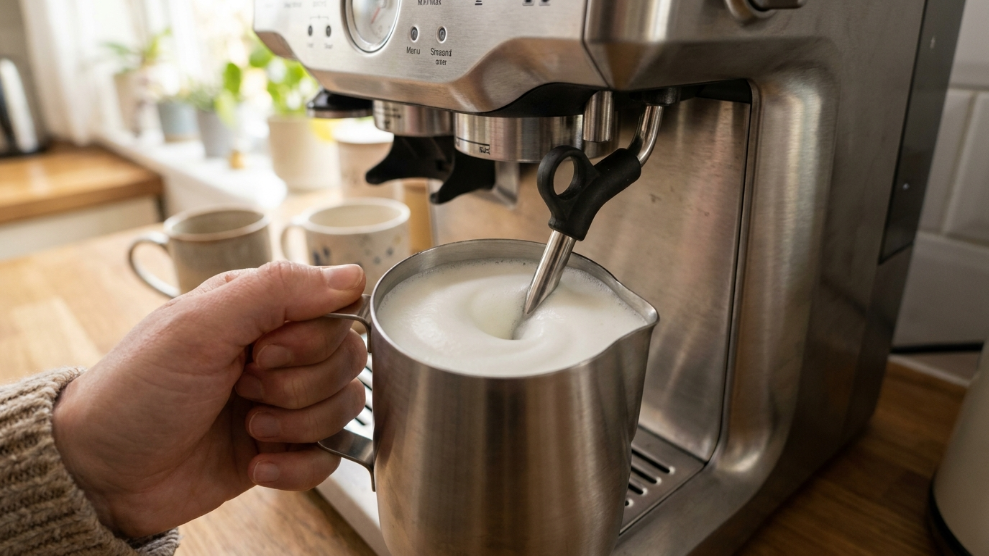
Introduce air for a very brief period 1 to 2 seconds maximum at the surface. You want a small amount of air incorporated, not the significant stretching you would do for a cappuccino. The goal is microfoam that has increased slightly in volume and feels silky and velvety, not foam that sits as a separate layer.
After the brief air introduction, submerge the wand slightly and create a smooth circular swirling motion. The milk should move in a continuous vortex. Stop at 60 to 65 degrees Celsius.
The correctly steamed flat white milk should look like liquid velvet glossy, smooth, with no visible bubbles. Tap the jug on the bench once and swirl to break any surface bubbles.
Step 4: Pour
The pour technique for an Australian flat white:
- Hold the cup at a slight tilt
- Position the jug close to the cup surface 2 to 3cm maximum
- Pour slowly and in a thin, controlled stream directly onto the espresso
- As the cup fills, lower the jug further and tilt it more to allow the microfoam to flow out with the milk
- In the final quarter of the pour, bring the jug to the surface and do a small lateral movement to create a white dot or simple heart in the surface
The ristretto and microfoam should blend into a caramel-brown drink with a thin white circular surface pattern. The milk and espresso should be fully integrated not separated into distinct layers.

Best Milk for an Australian Flat White
| Milk type | Foam quality | Notes for AU buyers |
|---|---|---|
| Whole milk (full cream) | Excellent | Gold standard. Full cream from any AU supermarket. Produces the richest, most integrated microfoam. |
| Reduced fat (light milk) | Good | Lower fat means slightly lighter microfoam. Works well. Popular for calorie-conscious buyers. |
| Oatly Barista Edition | Very good | Available at Woolworths, Coles, and specialty stores across Australia. The AU specialty cafe standard for dairy-free. |
| Minor Figures Oat Milk | Very good | British brand with strong AU distribution. Specialty cafes standard. Froths well with a steam wand. |
| Bonsoy | Good | Japanese soy milk brand widely available in AU specialty cafes. Produces good foam, slightly beany note. |
| Inside Out Oat Milk | Very good | Australian-made oat milk designed for barista use. Widely available in AU, good foam performance. |
| Standard supermarket oat milk | Poor | Regular (non-barista) oat milk separates and curdles on contact with hot espresso. Use barista edition only. |
AU oat milk note: Australia adopted oat milk in cafes earlier and more completely than most countries. Oatly Barista Edition, Minor Figures, and Inside Out are all widely available at Woolworths, Coles, and independent grocery stores. The AU specialty cafe community moved to oat milk as the default dairy-free option from approximately 2018 onwards.
Making a Flat White Without a Full Espresso Machine
Nespresso machine with milk frother
A Nespresso Original machine plus an Aeroccino 4 (which has a specific flat white / microfoam setting) produces a reasonable approximation. Use an espresso pod at the 40ml espresso size rather than the lungo setting. Use the flat white or microfoam function on the Aeroccino 4. The result is lighter than a true flat white but accessible and pleasant.
Breville Bambino (standard, without auto-steam)
The standard Bambino has a manual steam wand and produces good microfoam for flat whites with practice. Less sophisticated than the Plus model’s auto system but more skill-building.
AeroPress approximate
A concentrated AeroPress brew (18g coffee, 50ml water, 30-second steep, press quickly) makes a reasonable flat white base. Combined with well-frothed milk from a handheld frother or Aeroccino, this produces a coffee drink in the flat white style. It is not a true flat white but a workable approximation for occasions when an espresso machine is not available.
For the AeroPress method: AeroPress vs French Press
The Most Common Flat White Mistakes at Home
Mistake 1: Using regular espresso shots instead of ristretto. Standard espresso (1:2 ratio, 36g output from 18g coffee) in a 150ml flat white produces too much dilution. The ristretto (1:1.5, approximately 27g from 18g) concentrates the sweetness and creates the correct coffee presence for the small volume. This is the single most impactful change for buyers who already have an espresso machine.
Mistake 2: Too much milk. An Australian flat white is 150 to 160ml total. If your flat white is 200ml or more, it is a small latte. The smaller volume is not a limitation it is what creates the intense, satisfying character of the drink.
Mistake 3: Milk too hot. Milk steamed above 68 to 70 degrees Celsius loses sweetness and tastes scalded. Australian specialty cafes typically steam to 60 to 65 degrees. If your flat white tastes bitter at the milk stage, your steaming temperature is too high.
Mistake 4: Too much air in the milk. A flat white is not a cappuccino. The milk should not have a visible foam layer. If your flat white has foam sitting on top rather than integrating smoothly, you introduced too much air during steaming. The air introduction phase should be 1 to 2 seconds only.
Mistake 5: Stale beans. A flat white with two weeks post-roast whole beans is significantly better than one with pre-ground supermarket coffee regardless of technique. Fresh beans are the foundation. For freshness guidance: How to Store Coffee Beans
Frequently Asked Questions
What is the difference between an Australian flat white and a latte? Size, ratio, and espresso base. An Australian flat white is 150 to 160ml using double ristretto shots with a 1:3 coffee-to-milk ratio. A latte is 240 to 300ml using standard double espresso shots with a 1:4 to 1:5 ratio. The flat white is smaller, more intensely coffee-forward, and uses ristretto rather than standard espresso. In Australian cafes, ordering a flat white versus a latte is a meaningful distinction.
Do I need an espresso machine to make a flat white at home? To make a genuine Australian flat white: yes. The ristretto base requires 9-bar espresso pressure and the milk requires a steam wand for true microfoam. A Nespresso machine with an Aeroccino 4 produces an acceptable approximation but not the authentic result. An AeroPress with a handheld frother is a further approximation.
What size cup should I use for a flat white at home? 150 to 160ml is the Australian cafe standard. A standard 200ml cup produces a flat white that is slightly too milky by Australian standards. Invest in 150ml flat white cups widely available at kitchenware stores including Williams-Sonoma AU, Myer, and David Jones.
What is the correct milk temperature for an Australian flat white? 60 to 65 degrees Celsius. Australian specialty cafes typically steam to 63 degrees as a standard. At this temperature the milk is hot enough to drink comfortably but the natural sugars in the milk are intact, contributing sweetness to the drink. Above 70 degrees, the milk sugars begin to degrade and the milk tastes less sweet and slightly burnt.
Can I make a good flat white with oat milk in Australia? Yes, with the right oat milk. Oatly Barista Edition, Minor Figures, and Inside Out Oat all produce good microfoam with a steam wand and are the standard in Australian specialty cafes. Standard supermarket oat milk (non-barista edition) does not froth well and separates when it hits hot espresso. Always use a barista-specific oat milk.
How do I improve my latte art on flat whites? Latte art requires two things: consistently textured microfoam from a steam wand and a smooth, controlled pour. The flat white’s smaller size and less forgiving milk ratio makes latte art harder than on lattes where you have more margin. Master the milk texture first. The pour technique comes with practice. Most home baristas can produce a basic heart within 2 to 4 weeks of daily practice.
For the espresso machine that makes this achievable at home: Best Espresso Machines Australia 2026
For what makes a ristretto different from standard espresso: What Is a Ristretto?
For fresh beans that suit flat white espresso: Best Coffee Subscriptions 2026
Sources used in this article: Specialty Coffee Association Espresso and Milk Standards / Breville Australia Bambino Plus and Barista Express product documentation / Home-Barista.com Australian flat white community standards / Perfect Daily Grind The Australian Flat White Standard

Munir Ahmed is the founder of Coffee Craft Guide, dedicated to building the most thorough and honest coffee resource for home brewers worldwide. Combining SCA brewing standards with deep-dive research across global coffee communities (like r/espresso and Home-Barista) and thousands of verified reviews, Munir and his team deliver data-backed, expert coffee insights you can trust.