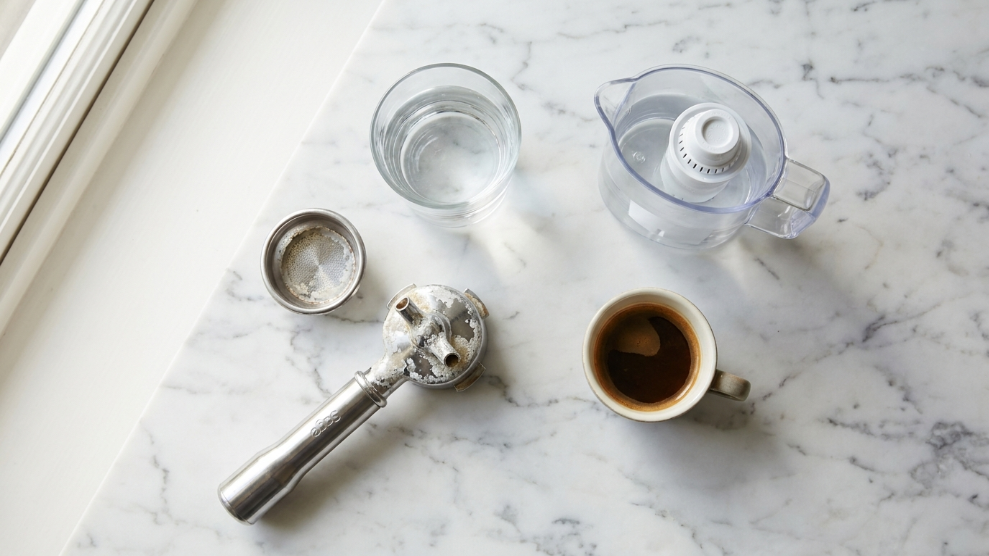
If you live in London, the South East, East Anglia, or the East Midlands, the water coming out of your tap is some of the hardest in Europe, with mineral levels regularly exceeding 300 mg per litre. This hard water affects your coffee in two distinct ways: it changes how your coffee tastes, and over time it damages your espresso machine.
This guide explains exactly what hard water does to your coffee and your equipment, which regions of the UK are most affected, and the specific products that fix the problem without making things worse by going too far in the other direction.
Table of Contents
How to Check Your Water Hardness Right Now
Before anything else, find out exactly how hard your water is.
The fastest method is entering your postcode at MyTapWater UK or Filter Flair’s water hardness map. Both cover all UK water company supply zones and give you the exact ppm (parts per million) figure for your postcode.
You can also buy a TDS (total dissolved solids) meter on Amazon for around £8 to £12. Fill a glass with tap water at room temperature, dip the meter, and the reading gives you the mineral concentration. This is the most accurate method because water hardness can vary slightly within the same postcode.
Hardness classification used by UK water companies:
| Classification | PPM (mg/L CaCO3) |
|---|---|
| Soft | Under 100 ppm |
| Moderately soft | 100 to 150 ppm |
| Slightly hard | 150 to 200 ppm |
| Moderately hard | 200 to 250 ppm |
| Hard | 250 to 300 ppm |
| Very hard | Over 300 ppm |
The Specialty Coffee Association recommends water between 75 and 250 ppm for optimal coffee extraction, with an ideal target of around 150 ppm.
UK Water Hardness by Region
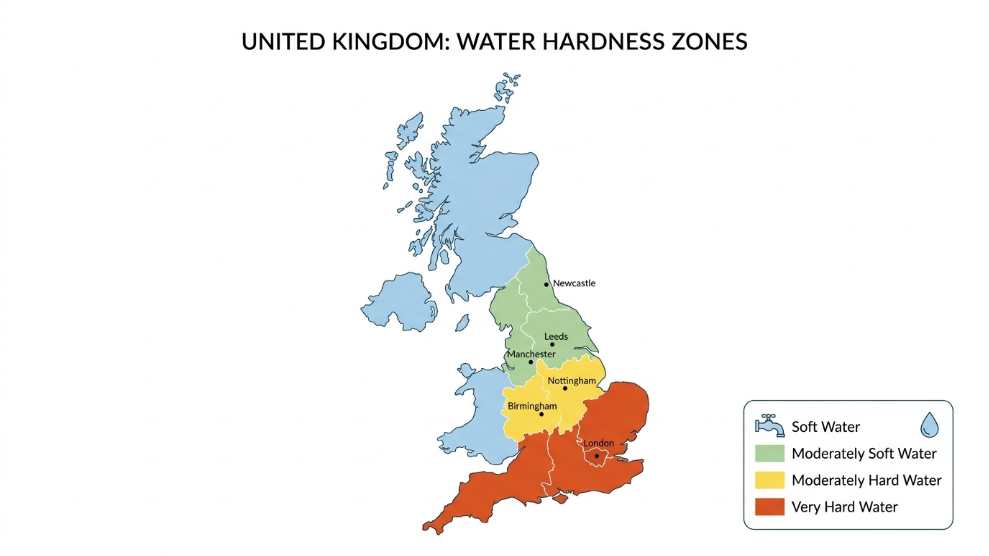
The divide across the UK is almost entirely geological. The South East and East of England sit on chalk and limestone aquifers that dissolve into the water supply, producing some of the hardest tap water in Europe. London, Hull, Cambridge, and Luton all exceed 300 mg/L. By contrast, Scotland, Wales, and the North West draw water from granite uplands and moorland reservoirs, giving cities like Glasgow, Manchester, and Liverpool some of the softest municipal water on the continent.
Practical guide by region:
| Region | Typical Hardness | PPM Range | Coffee Impact |
|---|---|---|---|
| London and South East | Very hard | 300 to 400 ppm | Strong effect on taste and machines |
| East Anglia (Cambridge, Norwich) | Very hard | 280 to 350 ppm | Strong effect |
| East Midlands (Leicester, Nottingham) | Hard | 220 to 300 ppm | Moderate to strong effect |
| Yorkshire | Moderately hard | 180 to 250 ppm | Moderate effect |
| West Midlands (Birmingham) | Moderately hard | 160 to 230 ppm | Moderate effect |
| North West (Manchester, Liverpool) | Slightly hard | 80 to 140 ppm | Minimal effect |
| North East (Newcastle) | Moderately soft | 70 to 120 ppm | Minimal effect |
| South West (Bristol, Devon, Cornwall) | Soft to moderate | 50 to 160 ppm | Minimal effect |
| Scotland (Glasgow, Edinburgh) | Soft | 20 to 80 ppm | See soft water note below |
| Wales | Soft to slightly hard | 40 to 150 ppm | Minimal to moderate |
| Northern Ireland | Soft | 30 to 100 ppm | Minimal effect |
The average hardness across England is approximately 230 ppm. If you are in London or the South East, your water is likely significantly above this average and above the SCA’s recommended maximum of 250 ppm for coffee.
How Hard Water Affects Your Coffee Taste
Hard water contains high concentrations of calcium and magnesium carbonate. These minerals interact with coffee compounds during extraction in two ways.
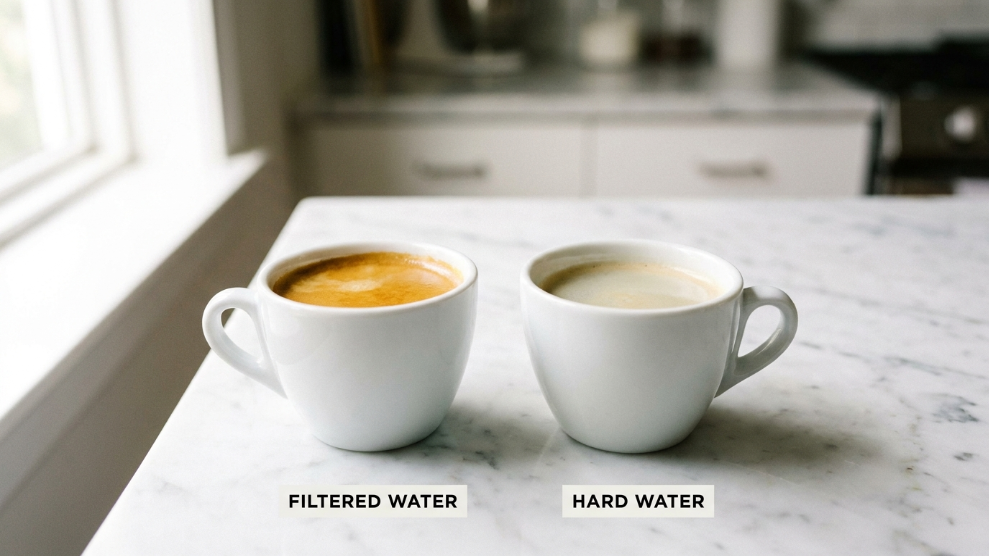
The main effect on espresso:
Water that is too hard reduces extraction efficiency. The high calcium content in very hard water competes with coffee compounds for binding sites during extraction, which means less of the desirable flavour compounds end up in your cup. The result is espresso that tastes flat, lacks sweetness, and often has a muted, chalky or mineral aftertaste even when shot time and grind are correct.
If you have followed the troubleshooting steps in our sour espresso guide and your espresso is still flat or off despite correct shot times, water is likely a significant contributing factor.
The effect on pour-over and filter coffee:
Hard water affects pour-over and filter brewing similarly. The mineral-heavy water produces a flatter, less sweet cup than the same beans brewed with filtered water of 75 to 150 ppm. This is particularly noticeable with light roast single-origin beans designed to highlight delicate floral and fruity notes, which are effectively suppressed by very hard water.
Soft water is also a problem:
Buyers in Scotland, Wales, and the North West should note that very soft water (under 75 ppm) also produces poor coffee. Very soft water lacks the minerals that help carry and bind coffee compounds during extraction, resulting in thin, sour, and lifeless coffee despite correct technique. If you are in a very soft water area, the solution is to add minerals rather than filter them out. Third Wave Water capsules (detailed below) are designed specifically for this situation.
How Hard Water Damages Your Espresso Machine
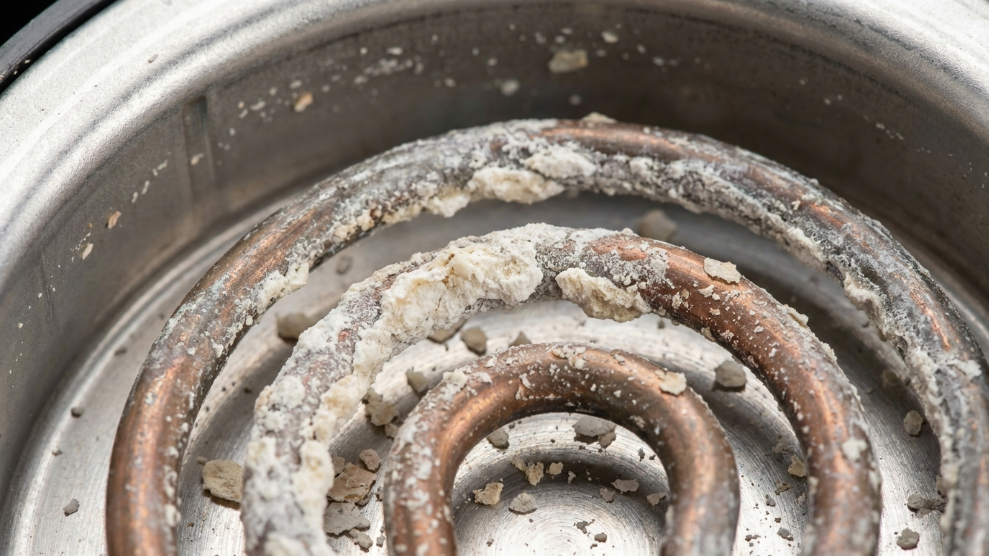
Limescale buildup inside your machine is the more serious long-term consequence of hard water, and it is the leading cause of espresso machine failure in the UK.
When hard water is heated, the calcium and magnesium carbonate minerals precipitate out of the water and bond to any metal surface they contact: the boiler, heating element, group head, and internal pipes. This process is the same one that leaves white deposits on your kettle.
Inside an espresso machine, limescale buildup:
Reduces heating efficiency because scale acts as an insulating layer, meaning the machine uses more energy to reach the same temperature. Just 1.6mm of scale increases energy use by 12% and shortens appliance lifespan.
Causes temperature instability because scale unevenly coats the boiler, creating hotspots that affect extraction consistency. This can cause shot-to-shot variation even when nothing else has changed.
Blocks internal components over time, eventually causing pump failure or blocked pipes that require expensive professional service or machine replacement.
Descaling frequency by water hardness:
| Water Hardness | Descaling Frequency |
|---|---|
| Very hard (over 300 ppm, London/South East) | Every 6 to 8 weeks |
| Hard (250 to 300 ppm) | Every 8 to 10 weeks |
| Moderately hard (200 to 250 ppm) | Every 10 to 12 weeks |
| Slightly hard (150 to 200 ppm) | Every 3 to 4 months |
| Soft (under 150 ppm) | Every 4 to 6 months |
Solutions: The Best Water for Coffee in the UK
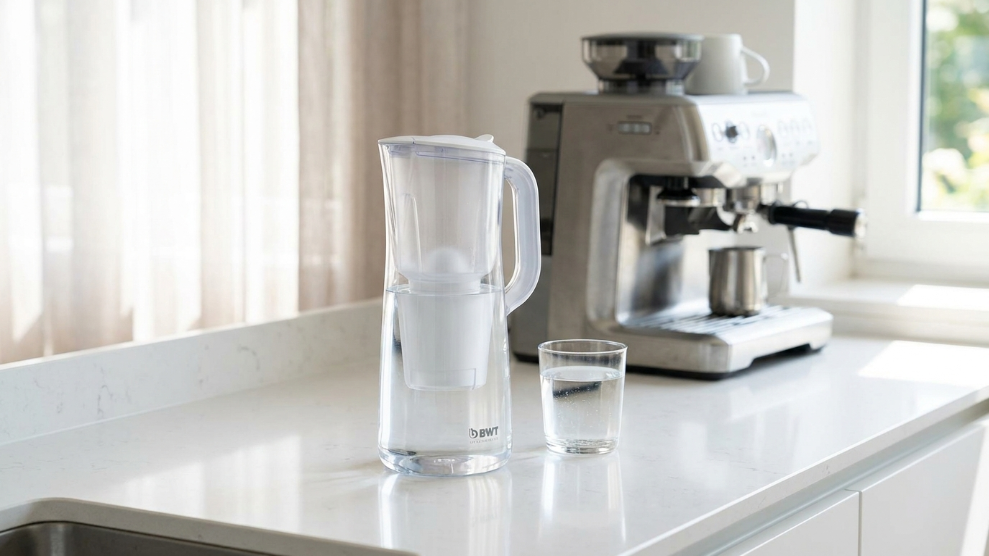
Option 1: BWT Penguin Filter Jug Best for Coffee (Recommended)
Check current price: Amazon UK BWT Penguin Water Filter Jug
Price: approximately £20 to £30. Replacement cartridges approximately £5 to £8 each.
The BWT Penguin is the most recommended water filter for coffee specifically in UK barista communities, and it is different from a standard Brita filter in an important way.
BWT is the Official Water Partner of the World Barista Championship. Their filter cartridges use magnesium mineralisation technology, meaning they not only remove excess calcium and limescale minerals but also add magnesium ions to the water. Magnesium is the mineral most responsible for enhanced coffee flavour development. The result is water with reduced hardness but enhanced coffee extraction properties.
For London and South East buyers, a BWT Penguin filter reduces water hardness from 300 to 400 ppm down to approximately 100 to 150 ppm, which falls into the SCA’s optimal coffee range. Multiple blind taste tests in specialty coffee communities have found filtered water from a BWT Penguin consistently produces noticeably better espresso and pour-over results compared to unfiltered London tap water.
Recommended filter lifespan: Replace the BWT cartridge every 4 weeks in very hard water areas, every 6 weeks in moderately hard areas. The filter capacity indicator on the jug tracks usage.
Option 2: Brita Maxtra+ Filter Jug
Check current price: Amazon UK Brita Marella Filter Jug with Maxtra+
Price: approximately £20 to £30. Replacement cartridges approximately £4 to £7 each.
The Brita Maxtra+ is the most widely available water filter in the UK, stocked in Sainsbury’s, Tesco, Boots, and most supermarkets, making replacement cartridges easy to source.
Brita reduces hardness and removes chlorine and some impurities, which improves both the taste and the machine safety of the water. It does not add magnesium like the BWT does, which means the coffee improvement is primarily from hardness reduction and chlorine removal rather than mineral enhancement.
For most UK buyers, a Brita filter produces meaningfully better coffee than unfiltered tap water and is a practical choice given the widespread availability of replacement cartridges. For buyers who want the best possible coffee water quality specifically, the BWT Penguin is the upgrade.
Option 3: Third Wave Water Capsules Best for Soft Water Areas
Check current price: Amazon UK Third Wave Water Coffee Minerals
Price: approximately £15 to £25 for a pack of 12 capsules.
Third Wave Water is an American product widely available in the UK through Amazon UK and specialty coffee retailers. Each capsule is designed to be dissolved in one gallon (3.8 litres) of distilled or near-zero TDS water to produce water at precisely 150 ppm, matching the SCA optimal coffee profile.
This is the solution for buyers in Scotland, Wales, and the North West who have very soft water and need to add minerals rather than remove them. Use distilled or reverse osmosis water as the base (available from supermarkets in the UK) and add one Third Wave Water capsule per 3.8 litres.
Third Wave Water comes in specific formulations: Espresso Profile and Classic Profile (for filter and pour-over). The difference is the calcium to magnesium ratio, which affects espresso crema and filter cup clarity differently.
For buyers who want the absolute best possible water chemistry for their coffee method, Third Wave Water is the enthusiast solution. For most buyers, a BWT or Brita filter is sufficient.
Option 4: Using the Machine’s Built-In Water Filter
All Sage and Breville espresso machines sold in the UK come with a built-in water filter cartridge for the water tank. This filter reduces limescale minerals before the water enters the machine.
Using this filter consistently:
- Reduces limescale buildup inside the machine
- Reduces descaling frequency
- Does not produce optimal extraction water quality on its own (it is designed to protect the machine, not to optimise coffee taste)
For best results in hard water areas: use the machine’s built-in filter AND fill the tank with pre-filtered water from a BWT or Brita jug. This dual filtering approach provides limescale protection at the machine level while also improving extraction water quality.
Replace the Sage or Breville water tank filter cartridge every 3 months or when the machine’s filter indicator prompts you.
Descaling Your Espresso Machine in the UK
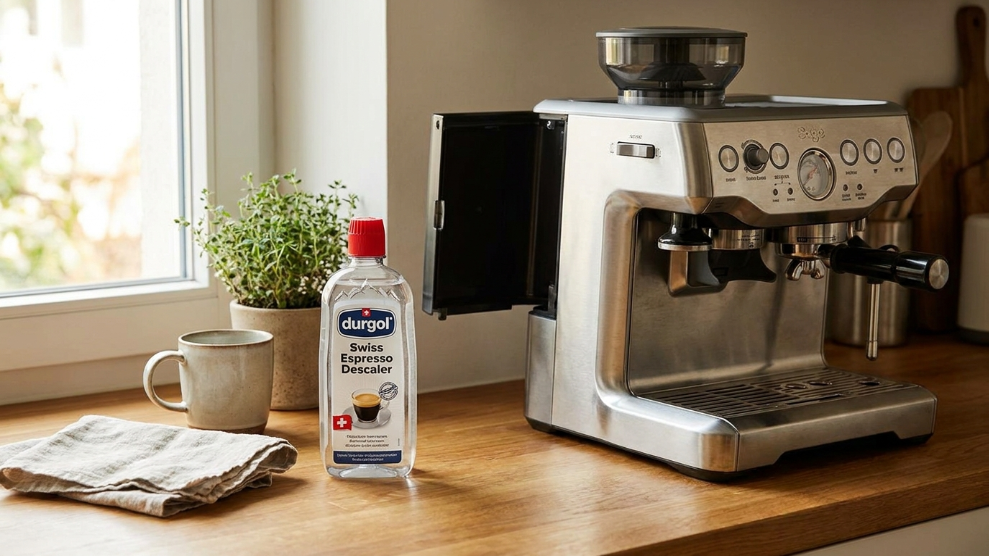
Recommended descaling solution for UK buyers:
Check current price: Amazon UK Durgol Swiss Espresso Descaler
Price: approximately £8 to £12 for two descaling applications.
Durgol Swiss Espresso is the most recommended descaler in UK home barista communities for Sage and Breville machines. It is safe for all machine components, works quickly (30 minutes for a full descaling cycle), and does not leave residual taste or smell.
The manufacturer-branded descalers from Sage (Sage Descaler, sold in pods at John Lewis and Amazon UK) and Breville are also safe and effective, though typically more expensive per application than Durgol.
Do not use white vinegar to descale espresso machines. Vinegar is acidic at a different pH than purpose-made descalers and can damage rubber seals and internal components in espresso machines specifically. It is appropriate for some kettle descaling but not for espresso machines.
Descaling steps for Sage Barista Express (UK):
- Fill the water tank with the descaling solution diluted as directed on the bottle (typically 125ml descaler with 1 litre of water)
- On the Sage Barista Express, hold the single-shot and power buttons simultaneously for 3 seconds to enter descaling mode
- Follow the machine’s prompt, which typically involves two cycles of descaler flowing through the machine and one cycle of clean water for rinsing
- Total time: approximately 30 minutes
- The machine beeps when the descaling cycle is complete
For De’Longhi machines, the descaling mode is entered by pressing the steam and hot water buttons simultaneously for 5 seconds.
Always consult your specific machine’s manual for the exact descaling mode entry procedure, as it varies between models.
Pour-Over and Filter Coffee in Hard Water Areas
Hard water affects pour-over and filter brewing differently than it affects espresso. The longer contact time in pour-over means there is more opportunity for mineral interference with extraction.
If you brew pour-over or V60 in London or the South East with unfiltered tap water and find your light roast specialty beans taste flat and lifeless despite correct ratio and technique, the water is almost certainly the cause.
For pour-over specifically, the combination of BWT-filtered water and a medium grind produces a noticeably more expressive cup from the same beans. Ethiopian Yirgacheffe and Kenyan AA single-origins, which are known for their floral and fruity notes, particularly benefit from lower mineral water.
See our full pour-over technique guide: Pour-Over Coffee Complete Guide
The cold brew method is less affected by water hardness because cold extraction is slower and the coarse grind and long steep time compensate somewhat for reduced extraction efficiency. Filtering is still recommended for best results in very hard water areas.
See: Cold Brew Coffee Complete Guide
Frequently Asked Questions
How do I know if hard water is affecting my coffee?
The clearest signs are: espresso that tastes flat or has a chalky or mineral aftertaste despite correct shot time and grind, visible limescale on your kettle building up quickly, white deposits forming on taps and shower screens, and pour-over that tastes muted despite fresh specialty beans and correct technique. If you are in London, the South East, or East Anglia, hard water is almost certainly affecting your coffee to some degree even if the effect is not dramatic.
Will a standard Brita filter improve my espresso?
Yes, meaningfully. Filtering London tap water (300 to 400 ppm) with a standard Brita Maxtra+ filter reduces hardness to approximately 150 to 200 ppm and removes chlorine, both of which improve espresso taste. For better results specifically for coffee, the BWT Penguin adds magnesium which further enhances extraction. Both are significantly better than unfiltered tap water in hard water areas.
My Sage machine is prompting me to descale very frequently. Is this normal?
Yes, if you are in London or the South East. The Sage Barista Express calculates descaling prompts based on water usage. Very hard water (300 to 400 ppm) triggers the descaling prompt significantly more often than soft water. Using the machine’s built-in water filter cartridge and pre-filtering water through a BWT or Brita jug reduces the frequency of descaling prompts because less limescale enters the machine.
Is hard water safe to drink?
Yes. Hard water is safe to drink, but it can affect taste and cause limescale buildup in appliances. The calcium and magnesium in hard water are not harmful and some research suggests they may provide minor health benefits. The concern for coffee drinkers is entirely about taste and machine longevity, not safety.
What about Scotland where the water is very soft?
Scotland draws water from granite uplands and moorland reservoirs, giving cities like Glasgow some of the softest municipal water on the continent. Very soft water (under 75 ppm) actually under-extracts coffee because it lacks the minerals that help carry coffee compounds during extraction. The result is sour, thin coffee. For Scottish buyers, the solution is to add minerals using Third Wave Water capsules dissolved in distilled water, or to use a specialist water product like Osmio Zero water with added coffee mineral packs.
Does hard water affect a Nespresso machine?
Yes. Nespresso machines require regular descaling in hard water areas. Nespresso provides its own descaling solution and the machines indicate when descaling is required. The frequency in London can be as often as every 4 to 6 weeks with heavy daily use.
Summary: Best Solution by UK Region
| Region | Hardness | Recommended Action |
|---|---|---|
| London, South East, East Anglia | Very hard 300+ ppm | BWT Penguin filter jug + machine’s built-in filter. Descale every 6 to 8 weeks. |
| East and West Midlands, Yorkshire | Hard 200 to 300 ppm | BWT or Brita filter jug. Descale every 8 to 12 weeks. |
| North West, North East | Slightly hard 80 to 200 ppm | Brita filter is sufficient. Descale every 3 to 4 months. |
| Scotland, Wales, North West soft areas | Soft under 75 ppm | Add minerals with Third Wave Water or similar. |
| South West | Variable | Check postcode. BWT or Brita if over 150 ppm. |
Check current price: Amazon UK BWT Penguin Water Filter Jug / Amazon UK Brita Marella Filter Jug / Amazon UK Durgol Espresso Descaler / Amazon UK Third Wave Water Coffee Minerals
Sources used for this article: MyTapWater UK water hardness checker / Filter Flair UK water hardness map / Specialty Coffee Association Water Quality Standards / Scale Free Home UK water hardness data

Munir Ahmed is the founder of Coffee Craft Guide, dedicated to building the most thorough and honest coffee resource for home brewers worldwide. Combining SCA brewing standards with deep-dive research across global coffee communities (like r/espresso and Home-Barista) and thousands of verified reviews, Munir and his team deliver data-backed, expert coffee insights you can trust.