
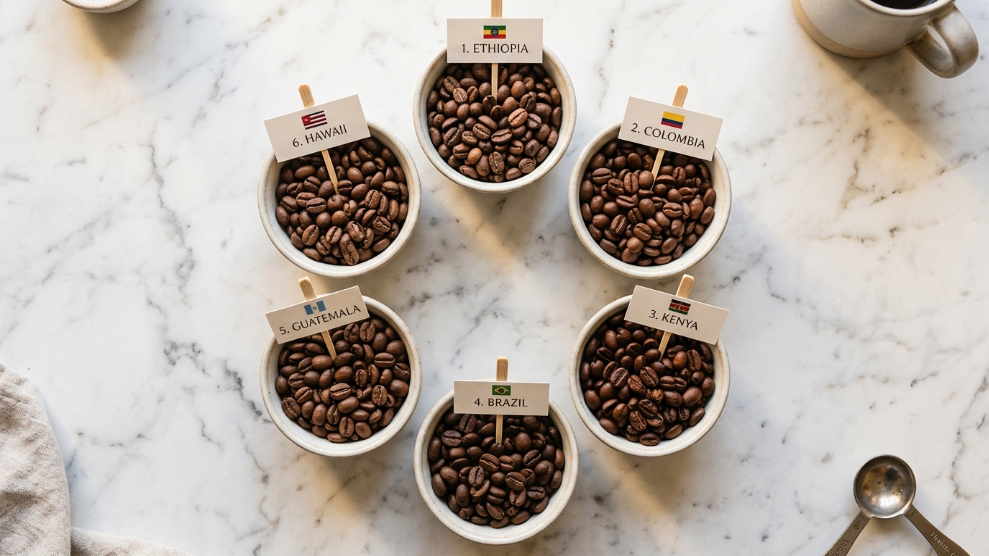
Coffee grown in Ethiopia tastes different from coffee grown in Colombia. Coffee from the Yirgacheffe region of Ethiopia tastes different from coffee grown in the Harrar region of the same country. These differences are not subtle. A trained palate can identify a Kenyan coffee from a Colombian one in a blind tasting almost every time. An experienced specialty buyer can often identify the region within the country.
Understanding where coffee comes from and what that means for your cup transforms coffee from a commodity into something to actively explore. This guide covers every major coffee producing region in the world, what each one tastes like, which sub regions produce the best specialty coffee, and how to try them.
Table of Contents
The Bean Belt: Where Coffee Grows
Coffee grows commercially only in a band of tropical and subtropical latitudes between roughly 25 degrees north and 30 degrees south of the equator. This region, known in the industry as the Bean Belt or Coffee Belt, encompasses parts of Africa, Asia, the Americas, and Pacific islands.
Within the Bean Belt, three factors determine coffee quality and flavour more than any others:
Altitude: Coffee grown at higher elevations (1,500 to 2,200 metres above sea level) matures more slowly due to cooler temperatures. Slower maturation allows more complex sugars and aromatic compounds to develop in the bean. High altitude coffees typically have more complex flavour profiles, brighter acidity, and greater aromatic clarity than low altitude coffees.
Soil: Volcanic soil, which is mineral rich and well draining, is ideal for coffee cultivation. Ethiopia, Colombia, Guatemala, and Hawaii all benefit significantly from volcanic geology. The specific mineral composition of soil affects which compounds develop in the coffee cherry during maturation.
Rainfall and dry seasons: Coffee requires adequate rainfall during growing and flowering but needs a defined dry season for cherry ripening and harvest. Regions with two harvest seasons per year (Colombia, Kenya) can maintain year round production, while single harvest countries (Brazil, Ethiopia) have distinct crop years.
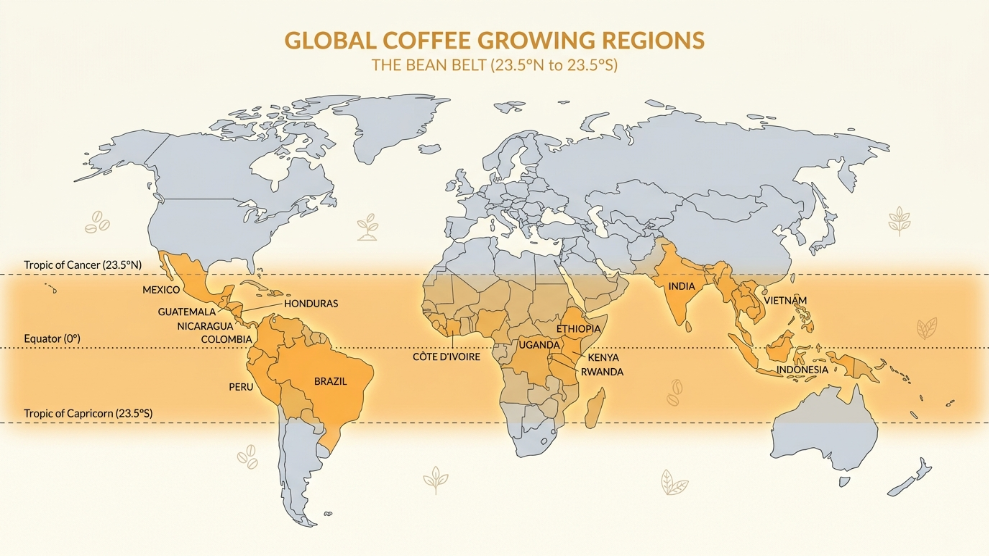
Global Coffee Production by Country (2024 to 2025 Data)
According to International Coffee Organization trade data and USDA FAS 2025/26 crop year forecasts:
| Country | Annual Production | Type | Specialty Relevance |
|---|---|---|---|
| Brazil | 64.70 million 60 kg bags | Arabica and Robusta | High natural Arabica specialty lots score 85 to 88 |
| Vietnam | 29 million bags | Primarily Robusta | Low mostly commercial and instant |
| Colombia | 13.2 million bags | Arabica | Very high clean, traceable, scores 85 to 88 |
| Indonesia | 10.7 million bags | Arabica and Robusta | Moderate Sumatra specialty lots |
| Ethiopia | 10.63 million bags | Arabica | Highest consistently scores 88 to 92 |
| Uganda | 6.7 million bags | Primarily Robusta | Low specialty |
| India | 6.2 million bags | Arabica and Robusta | Moderate Monsoon Malabar specialty |
| Honduras | 5.52 million bags | Arabica | Moderate growing specialty sector |
| Peru | 3.88 million bags | Arabica | Moderate organic specialty |
| Mexico | 3.87 million bags | Arabica | Moderate |
Source: USDA Foreign Agricultural Service 2024/2025 season data, World Coffee Research.
Note: Production volume and specialty quality are different things. Vietnam is the second largest producer globally but produces minimal specialty grade coffee. Ethiopia is fifth by volume but consistently produces the world’s highest scoring specialty lots.
☕ Free Tools & Printables
However you brew these beans, get the ratio right with our Coffee to Water Ratio Calculator. Free download: see every growing region on the Coffee Origin World Map (PDF).
Africa: The Origin Continent
Africa is where coffee was first discovered and cultivated. Ethiopian legends trace coffee’s origin to a goat herder named Kaldi who noticed his goats became energetic after eating berries from a particular tree. Botanically, all Coffea arabica varieties trace their ancestry to Ethiopia and the surrounding region.
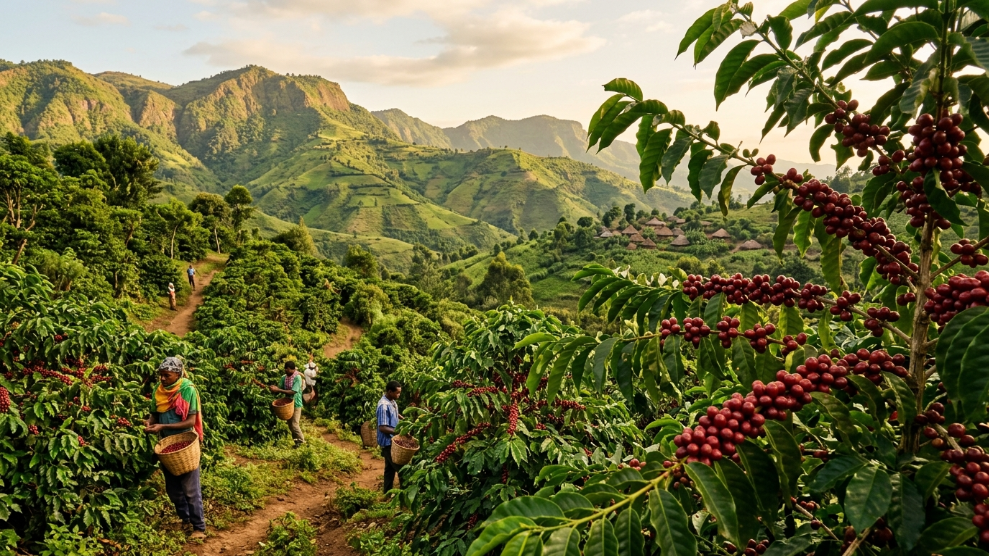
Ethiopia The World’s Specialty Champion
Production: 10.63 million 60 kg bags (2024/2025) Altitude: 1,500 to 2,200 metres Processing: Washed and natural, both common SCA scores: Regularly 88 to 92 on exceptional lots
Ethiopia consistently produces the highest scoring specialty coffee in the world according to World Coffee Research. No other country matches the genetic diversity of Ethiopian coffee. Unlike nearly all other major producing countries where coffee arrived as an introduced crop, Ethiopia has indigenous wild coffee varieties that exist nowhere else on Earth. This genetic diversity creates flavour possibilities unavailable in any other origin.
Key regions within Ethiopia:
Yirgacheffe: The most internationally recognised Ethiopian region. Washed processed Yirgacheffe is famous for jasmine and blueberry aromas, bergamot, citrus, and tea like delicacy. It is the coffee most associated with the “floral Ethiopian” profile that surprises first time specialty drinkers. Natural processed Yirgacheffe produces more fruit forward, wine like cups.
Sidama (Sidamo): Broader region surrounding Yirgacheffe with similar profiles, generally slightly earthier and fuller bodied. SCA scores regularly reach 85 to 90.
Guji: An increasingly recognised sub zone of Sidama producing coffees with exceptional clarity. Competition level lots from Guji regularly score 88 to 91.
Harrar (Harar): Eastern Ethiopia, entirely naturally processed. Harrar produces wine like, fruity, complex coffees with a distinctive blueberry and dark chocolate profile. More rustic than the cleaned-up washed Yirgacheffe profiles.
Best brewing method for Ethiopian coffee: Pour-over (V60, Chemex) at 94°C with a 1:16 ratio. The clean, delicate aromatics of washed Yirgacheffe are best experienced in a method that preserves cup clarity. See: Pour-Over Coffee Complete Guide
Try it: Atlas Coffee Club regularly features Ethiopian single-origins from Yirgacheffe and Guji. Volcanica Coffee carries traceable Ethiopian lots.
Kenya The Bold and Complex
Production: Approximately 800,000 to 900,000 60-kg bags (smaller producer, high quality focus) Altitude: 1,400 to 2,000 metres Processing: Primarily washed (double-fermented) Grading: Kenya grades by bean size: AA (largest), AB, C, PB (peaberry) SCA scores: 85 to 89 on premium lots
Kenyan coffee is among the most distinctive of any origin. The double-fermented washed processing method, unique to Kenya, removes the fruit in two stages over 72 hours, producing exceptional clarity and a signature bright acidity. Kenyan AA is described by experienced tasters as having blackcurrant, tomato, red grape, and black tea notes with structured, bold acidity that is unlike any other producing country.
Key regions within Kenya:
Nyeri: Considered Kenya’s finest growing region. Coffees from Nyeri have exceptional structure, complex fruit, and remarkable longevity in the cup. Nyeri AA is a benchmark specialty lot globally.
Kirinyaga (Mount Kenya): High altitude slopes of Mount Kenya produce structured, blackcurrant-forward coffees with excellent balance.
Murang’a: Softer, more rounded profiles than Nyeri. Good entry point for Kenya.
Best brewing method: Pour-over or filter at 96°C (higher than most origins). Kenyan coffee benefits from higher brew temperature to extract its structured acidity properly.
Rwanda The Rising African Star
Altitude: 1,600 to 2,000 metres Processing: Washed SCA scores: 84 to 88 on premium lots
Rwanda has transformed its coffee sector since the early 2000s into one of Africa’s most respected specialty producers. Rwandan coffees show citrus, stone fruit, and caramel sweetness with clean, bright acidity. The country consistently places coffees in international competition.
Tanzania Kilimanjaro Coffees
Altitude: 1,400 to 2,000 metres on the slopes of Kilimanjaro and the Southern Highlands Processing: Washed and natural Profile: Bright, citrusy, blackberry, with medium body
Tanzania produces both Arabica and Robusta. The Arabica from Kilimanjaro slopes produces coffees similar to Kenyan profiles, slightly less intense but equally interesting.
The Americas
The Americas produce the widest variety of specialty coffee profiles of any continent, from Brazil’s full-bodied naturals to Panama’s extraordinarily priced Geisha micro-lots.
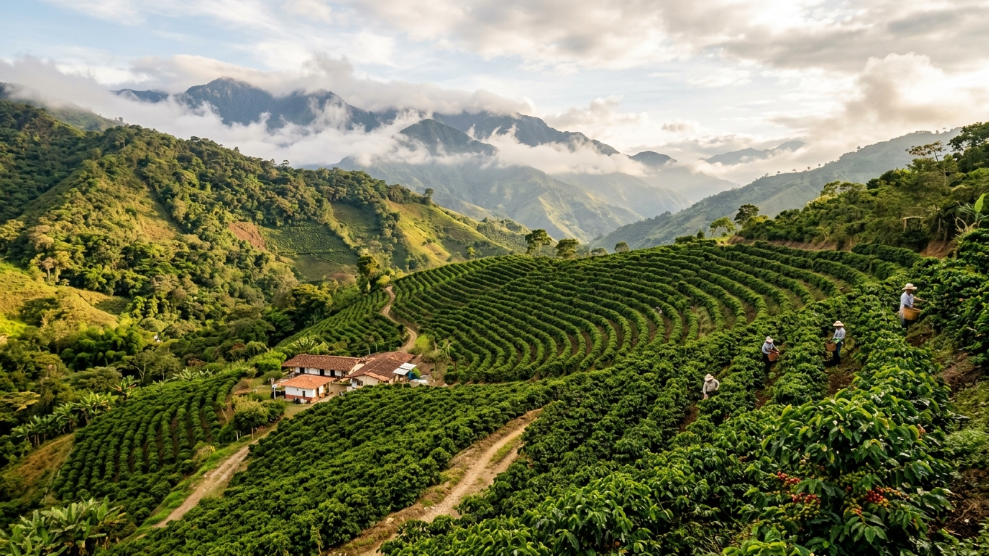
Colombia The Benchmark of Balance
Production: 13.2 million 60-kg bags (third largest globally) Altitude: 1,200 to 2,000 metres Processing: Primarily washed SCA scores: 84 to 88 on specialty lots Harvest: Two seasons per year (main October to December, mitaca April to June)
Colombia’s two annual harvest seasons mean fresh Colombian coffee is available year-round, which no equatorial single-harvest country can match. Colombian Arabica is grown across the Coffee Cultural Landscape, a UNESCO World Heritage site in the Andes, by approximately 500,000 small-scale family farmers.
Colombian coffee is the benchmark for accessible, reliable specialty coffee. Its profile is balanced, with bright red apple acidity, caramel sweetness, and mild nuttiness, making it one of the most versatile origins for both filter and espresso brewing.
Key regions within Colombia:
Huila: Considered Colombia’s finest growing region for specialty. Rich volcanic soil, high altitude, and year-round harvesting produce complex coffees with fruit, caramel, and floral notes.
Nariño: High altitude (up to 2,300 metres) produces some of Colombia’s most acidic and complex coffees. Nariño lots regularly win Colombian Cup of Excellence competitions.
Antioquia, Caldas, Tolima: The traditional heart of Colombian coffee production. Clean, balanced, reliable quality.
Cauca: Increasingly recognised for nuanced, fruit-forward specialty lots.
Try it: Trade Coffee features Colombian specialty lots matched to your taste profile. Atlas Coffee Club regularly includes Colombian single-origins.
Brazil The World’s Largest Producer
Production: 64.70 million 60-kg bags (approximately 35% of global supply) Altitude: 500 to 1,200 metres (lower than most specialty regions) Processing: Primarily natural and honey, some washed SCA scores: Natural Arabica specialty lots score 85 to 88 from Minas Gerais
Brazil’s dominance in volume is matched by its consistency. Lower altitude than East African or Andean origins produces coffee with less bright acidity and more body. Natural processing adds fruit sweetness and chocolate depth.
Brazilian coffee is the base of most commercial espresso blends globally. The smooth, low-acid, nutty, chocolatey profile blends well with high-acidity origins to create balanced espresso. As a single origin, Brazilian specialty naturals have developed a significant following for their dessert-like sweetness.
Key regions within Brazil:
Minas Gerais (Sul de Minas): Brazil’s most important specialty region. Lots from Minas Gerais score 85 to 88 and carry stone fruit, chocolate, and nutty sweetness.
Cerrado Mineiro: First Brazilian region to receive geographical indication status. Clean, consistent natural lots.
São Paulo (Mogiana): Bordeaux region of Brazilian coffee. Rich, complex naturals.
Best for: Cold brew at 1:8 ratio. Brazilian medium-dark naturals in cold brew produce exceptional chocolate and caramel sweetness. See: Cold Brew Coffee Complete Guide
Guatemala Chocolate, Spice, and Body
Production: Approximately 3.5 million 60-kg bags Altitude: 1,300 to 1,800 metres Processing: Washed and honey SCA scores: 83 to 87 on specialty lots
Guatemalan coffee is among the most body-forward specialty coffees available. The volcanic soil of regions like Antigua and Huehuetenango gives Guatemalan beans a chocolatey, brown spice, and sometimes tobacco character with a rich, full body that works exceptionally well for espresso and cold brew.
Key regions:
Antigua: Classic Guatemalan profile. Rich chocolate, dark sugar, full body. One of Central America’s most famous coffee regions.
Huehuetenango: Higher altitude, more complex and fruity profiles. Considers itself Guatemala’s finest region for specialty.
Atitlan: Around Lake Atitlan. Volcanic soil produces coffees with distinct cocoa and fruit character.
Costa Rica Innovation in Processing
Production: Approximately 1.5 million 60 kg bags Altitude: 1,200 to 1,900 metres Processing: Washed, honey, and natural honey processing was pioneered here
Costa Rica played a significant role in developing honey processing as a mainstream specialty technique, and the country continues to be a centre of processing innovation. Coffees range from clean, bright washed lots to complex, fruity honey processed coffees from micro mills.
Profile: Clean, bright acidity, stone fruit, citrus, honey sweetness. Yellow honey processing produces balanced cups; red and black honey processing produces more complex fruit character.
Panama The Most Expensive Coffee in the World
Panama produces small volumes of coffee but has made an outsized impact on specialty coffee through one variety: Geisha (also spelled Gesha).
The Geisha variety, originally from Ethiopia, was brought to Panama and planted at high altitude farms in the Boquete region. At a 2004 specialty coffee competition, Hacienda La Esmeralda’s Geisha won the Best of Panama competition at a price that shocked the industry. Geisha’s floral jasmine, bergamot, and tropical fruit profile is unlike any other coffee variety.
Panama Geisha auctions now regularly achieve $800 to $1,500+ per pound for top lots the highest prices in the coffee world. For specialty enthusiasts, even small sample quantities of Panama Geisha represent a unique coffee experience.
Caribbean and Pacific Islands
Hawaii (Kona) America’s Premium Coffee
Production: Approximately 2,300 tons (modest volume, premium pricing) Altitude: 500 to 900 metres on the slopes of Mauna Loa Processing: Washed Profile: Smooth, clean, mild acidity, light body, slight nuttiness
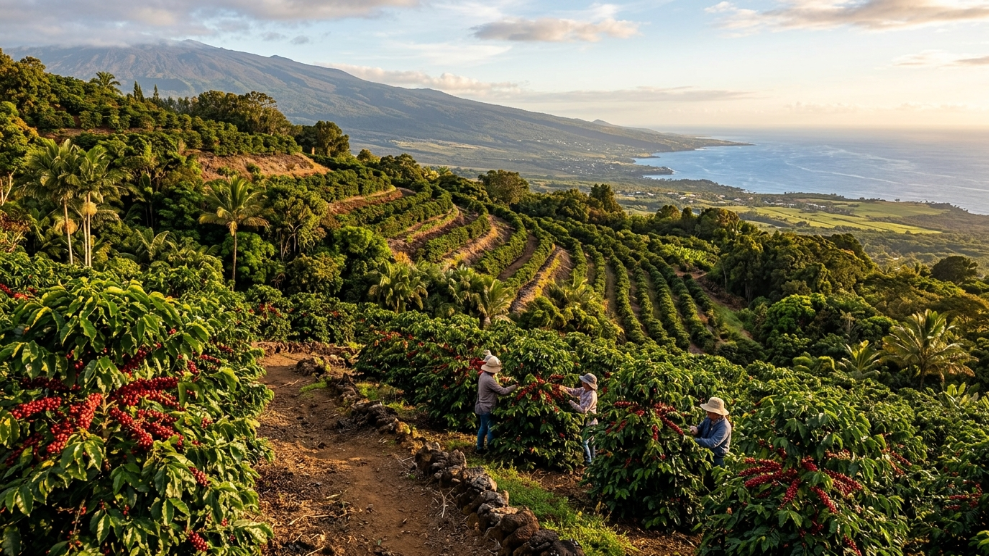
Hawaiian Kona coffee is one of the most geographically protected coffees in the world. Genuine Kona can only be grown in the Kona district of Hawaii’s Big Island. The specific combination of volcanic soil, altitude, morning sun, and afternoon cloud coverage creates a flavour profile unavailable anywhere else.
The critical purchasing warning: Hawaii state law allows the label “Kona blend” with as little as 10% actual Kona content. Much of the “Kona coffee” sold in supermarkets and on Amazon contains minimal genuine Kona. Always purchase from producers who explicitly state 100% Kona certification.
Best source for authentic Kona: Koa Coffee sells exclusively 100% certified Big Island Kona, verified by the Hawaii Department of Agriculture.
Full review: Koa Coffee Review
Jamaica Blue Mountain The Original Luxury Coffee
Altitude: 910 to 1,700 metres in the Blue Mountains of Jamaica Profile: Mild, balanced, clean, very low bitterness, gentle sweetness Price: Among the most expensive commercially available coffees ($50 to $80 per 250g)
Jamaica Blue Mountain coffee is one of the most internationally recognised coffee names but also one of the most frequently counterfeited. Genuine Blue Mountain is regulated by the Coffee Industry Board of Jamaica and must be grown in the designated Blue Mountain region.
The profile is mild and extremely clean valuable to those who find most coffee too acidic or bitter. Whether the price premium over other mild specialty coffees is justified is genuinely debated among specialty coffee professionals.
Papua New Guinea The Underappreciated Pacific Origin
Altitude: 1,200 to 1,800 metres in the Highlands Processing: Washed and natural Profile: Earthy, fruity, medium body, sometimes wine like
Papua New Guinea produces genuinely interesting specialty coffee from Arabica varieties descended from Jamaican Blue Mountain stock brought to PNG in the 1920s. PNG coffees receive less attention than they deserve in specialty markets. Atlas Coffee Club occasionally features PNG lots as part of their Pacific rotation.
Asia and the Middle East
Indonesia Earthy, Full Bodied, Unique
Production: 10.7 million 60-kg bags (primarily Robusta, some specialty Arabica) Altitude: 750 to 1,500 metres Processing: Wet-hulled (Giling Basah) unique to Indonesia
The wet-hulled processing method used in Indonesia, particularly in Sumatra, produces a flavour profile found nowhere else: low acidity, very full body, earthy, mossy, dark chocolate, and sometimes smoky or herbal notes. This profile is highly polarising some specialty drinkers love its unusual complexity while others find it unpleasantly earthy.
Key Indonesian regions:
Sumatra (Mandheling, Lintong, Gayo): The most famous Indonesian origin. Full body, low acidity, earthy, herbal, dark chocolate.
Sulawesi (Toraja): Cleaner than Sumatra, some fruit character, still full-bodied.
Bali: More delicate than Sumatra, slight floral notes.
Java: Historically one of the most famous coffee origins (the word “java” as a synonym for coffee comes from this island). Modern Java coffee is cleaner than Sumatra.
Yemen The Ancient Origin
Production: Very small volumes, significant supply chain challenges Altitude: 1,400 to 2,500 metres Processing: Natural (traditional sun-drying in whole fruit) Profile: Wine-like, exotic spice, dark fruit, complex fermented notes
Yemen is considered alongside Ethiopia as one of the oldest coffee-producing and consuming cultures in the world. Yemeni coffee was the dominant traded coffee in the world from the 15th to 18th centuries, shipped through the port of Mocha (hence the word mocha). Ongoing geopolitical instability has made Yemeni coffee difficult to source reliably, which has driven prices to extremely high levels for the small volumes that reach international markets.
For adventurous specialty drinkers, Yemeni coffee offers a unique window into coffee’s ancient history and a flavour profile unavailable from any other origin.
India Monsoon Malabar
Production: 6.2 million bags (Arabica and Robusta) Specialty distinction: Monsoon Malabar
India’s most internationally distinctive coffee is Monsoon Malabar, a processing technique unique to the Malabar coast. Green coffee beans are exposed to monsoon winds and humidity in open warehouses for 12 to 16 weeks, causing them to swell and lose most of their acidity while developing a distinctive musty, earthy, and spicy character. The result is extremely low-acid, full-bodied, unique coffee that is popular in Italian espresso blends for its body contribution.
Vietnam Robusta Powerhouse
Production: 29 million bags (second largest globally) Type: Primarily Robusta
Vietnam is an enormous producer but specialises in Robusta rather than Arabica. Robusta contains approximately double the caffeine of Arabica and has a stronger, more bitter, rubbery flavour that is not suitable for specialty filter brewing but works well in espresso blends, Vietnamese iced coffee (ca phe sua da), and instant coffee production. Vietnam’s coffee is not typically discussed in specialty coffee contexts but is commercially significant.
How Altitude Changes Coffee Flavour
Altitude is the single most reliable predictor of coffee flavour complexity. Higher altitude creates cooler growing temperatures which slow cherry maturation, allowing more sugar development and aromatic compound accumulation. This is why specialty coffee consistently comes from high-altitude regions and why lower-altitude Robusta (typically below 900 metres) rarely produces specialty-grade flavour.
Altitude and typical profiles:
- Under 800 metres: Robusta growing zone, earthy, high caffeine, little complexity
- 800 to 1,200 metres: Low-altitude Arabica, mild, clean, limited complexity
- 1,200 to 1,500 metres: Mid-altitude specialty, balanced, developing complexity
- 1,500 to 1,800 metres: High-altitude specialty, complex, bright, excellent clarity
- Above 1,800 metres: Very high altitude, exceptional complexity, intense fruit and floral notes
How to Explore Coffee Origins at Home
The best way to understand regional differences is to buy single origin coffees from different regions in succession and compare them using the same brew method and ratio.
Recommended exploration sequence:
- Colombian washed the benchmark balanced reference
- Ethiopian Yirgacheffe washed floral, bright, the contrast to Colombia
- Brazilian natural full body, chocolate, the low acid contrast
- Kenyan AA washed the bold, blackcurrant contrast
- Indonesian Sumatra earthy, full body, the extreme contrast to Ethiopia
Brewing all five with the same pour-over method at 1:16 ratio illustrates the full range of what coffee can taste like.
Best subscription for exploring regions: Atlas Coffee Club sends a different country each month with tasting notes and origin information. Available for USA, UK, Australia, Canada, and New Zealand.
Full subscription guide: Best Coffee Subscriptions 2026
What specialty coffee grading means for these origins: What Is Specialty Coffee?
Frequently Asked Questions
Which country produces the best coffee in the world?
Ethiopia consistently produces the highest-scoring specialty coffee globally, with cupping scores reaching 88 to 92 on exceptional lots from Yirgacheffe, Sidama, and Guji according to World Coffee Research data. Colombia, Kenya, and Panama also produce elite specialty lots regularly. Which country produces the best coffee for your personal taste depends on your preferred flavour profile: Ethiopia for floral and fruity, Colombia for balance, Kenya for bold brightness, Brazil for chocolate and body.
What is the largest coffee-producing country in the world?
Brazil. According to USDA FAS data for the 2024/2025 crop year, Brazil produces approximately 64.70 million 60-kilogram bags per year, representing roughly 35% of global coffee supply. This is more than double Vietnam’s output and nearly five times Colombia’s production.
What does single origin coffee mean?
Single origin means the coffee comes from one specific location rather than being blended from multiple origins. The term ranges in specificity from country level (Ethiopian coffee) to farm level (Finca La Esmeralda, Panama). Most specialty subscriptions use country or regional single origins. See our full guide: What Is Specialty Coffee?
What is the most expensive coffee in the world?
Panama Geisha from top farms like Hacienda La Esmeralda regularly achieves $800 to $1,500 or more per pound at specialty auction. Other contenders include Jamaica Blue Mountain, Hawaiian Kona, and Yemeni Mocha. Kopi Luwak, coffee processed through the digestive system of civets, was once the most famous expensive coffee but is now less respected in specialty circles due to animal welfare concerns and questionable quality.
Is Vietnamese coffee specialty?
Generally no. Vietnam produces primarily Robusta, which lacks the genetic capacity for specialty-level cup profiles. Some Vietnamese Arabica grown in high-altitude regions like Da Lat shows specialty potential, but this represents a small fraction of Vietnam’s total production which is dominated by commercial-grade Robusta for instant coffee and blends.
What makes Hawaiian Kona coffee special?
Kona coffee’s distinctiveness comes from the specific combination of volcanic soil from Mauna Loa, the altitude of the Kona district, the morning sun and afternoon cloud pattern that moderates temperature, and the geographical isolation of Hawaiian growing conditions. The result is a smooth, clean, mild coffee with low bitterness that is genuinely different from continental coffees. The rarity of the growing area (limited to approximately 2,000 acres in the Kona district) also contributes to premium pricing.
Sources used for this article: World Coffee Research / International Coffee Organization / DataPandas Coffee Production / Indonesia Specialty Coffee / Specialty Coffee Association

Munir Ahmed is the founder of Coffee Craft Guide, dedicated to building the most thorough and honest coffee resource for home brewers worldwide. Combining SCA brewing standards with deep-dive research across global coffee communities (like r/espresso and Home-Barista) and thousands of verified reviews, Munir and his team deliver data-backed, expert coffee insights you can trust.